
Small things that keep a trip relaxed.
Travel planning
Is Marrakech safe?
Yes, for the vast majority of visitors. Violent crime against tourists is rare; what you will meet is hustle: touts, fake guides and inflated prices. Knowing the tricks takes most of the stress away.
Millions of visitors come to Marrakech every year, and the large majority leave with nothing worse than a carpet they paid too much for. The city is busy, loud and sometimes pushy, especially around Jemaa el-Fna and the souks, but it is not dangerous in the way people sometimes fear.
This page gives the honest picture: what the US and UK governments say, the risks that are real, the scams you are likely to meet and how to deal with them, plus specific advice for women and LGBT+ travellers.
- US advisory
- Level 2 of 4
- Main risk
- Pickpockets, scams
- Police
- 19 (tourist police too)
- Ambulance
- 15
The real risks
What governments say, and what visitors meet
The official advice is the same as for much of Europe. The everyday risks are smaller and easier to manage.
| Risk | How likely | What to do |
|---|---|---|
| Pickpockets and bag snatching | Possible in crowds: Jemaa el-Fna, the souks, festivals | Crossbody bag worn in front, phone in a front pocket, no jewellery on show |
| Scams and fake guides | Very likely to be tried at least once | Say a firm “no thank you” early; book guides through your riad or a licensed agency |
| Traffic | The most real physical danger | Scooters in the Medina lanes, fast roads outside it. Cross with locals; avoid driving at night |
| Stomach upsets and sun | Common, usually mild | Bottled or filtered water, busy food stalls, a hat and water in summer |
| Terrorism | Low, but it is the reason for official warnings | Stay aware in crowded places and avoid demonstrations |
The US State Department rates Morocco at Level 2, “exercise increased caution”, mainly for terrorism: the same level it gives France, Spain and the United Kingdom. The UK Foreign Office advice, updated in October 2026, warns about petty theft in medinas, bogus guides and protests that can start without warning. Neither advises against travel to Marrakech.
Morocco has suffered attacks: a bomb at the Argana café on Jemaa el-Fna in 2011, and the murder of two hikers near Imlil in 2018. Security in tourist areas was reinforced afterwards, and you will see plain-clothes and tourist police around the main squares.
Common scams
Eight tricks you may meet
None of these is dangerous. All of them cost money or time, and all are easy to sidestep once you know them.
| The trick | How it goes | What to do |
|---|---|---|
| “This road is closed” | A stranger says the lane ahead is closed, or the square is that way, and leads you to a shop or asks for money | Thank him and keep walking. Check your offline map |
| The unofficial guide | A friendly man offers to show you the souks or the tanneries, then expects a big tip or commission | Licensed guides carry an official badge. Book through your riad |
| The tannery tour | You are led to a “cooperative” and pressed to buy leather after a free visit | Go with a guide, or simply leave after the view. A small tip is enough |
| Henna by surprise | A woman on Jemaa el-Fna takes your hand and starts drawing, then asks a high price | Keep your hands to yourself and say no clearly, before the first line |
| Photos with animals | Monkeys or snakes are put on you for a photo, then you are asked for a lot of money | Avoid: the animals are often badly treated. If you take a photo of a performer, agree 10–20 MAD first |
| The taxi without a meter | The driver “forgets” the meter or quotes three times the fare | Ask for the meter before you sit down, or wave the next one |
| The menu with no prices | At some food stalls and restaurants, extras you did not order appear on the bill | Ask for prices first, check the bill item by item |
| The special market | You are told a Berber market or festival is on “today only” | There is no such hurry. Buy when you want, where you want |
Women & LGBT+
Travelling as a woman, or as a couple
Many women travel to Marrakech alone and enjoy it. Expect attention, rarely anything worse, and a few habits make a real difference.
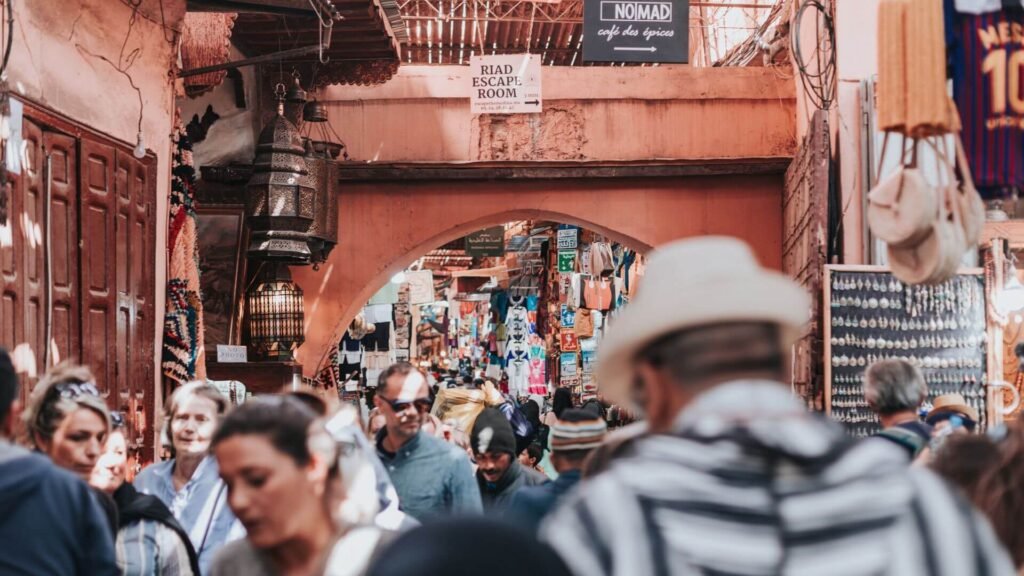
Comments, calls and men walking alongside for a few steps are the most common complaint, especially in the souks and around Jemaa el-Fna. It is tiring rather than threatening. Not answering, not stopping and walking on with purpose usually ends it; a firm “safi” (enough) or “hshuma” (shame) works if it does not.
Loose clothes that cover the shoulders and knees draw less attention in the Medina; in Gueliz, hotels and the Palmeraie, anything goes. In the evening, main lanes and squares stay busy and feel safe; for quiet lanes after dark, ask your riad to meet you or take a taxi. Women-run riads, hammams and cooking classes are easy to find and a good way to meet Moroccan women.
For LGBT+ travellers: same-sex relations are illegal in Morocco and public displays of affection are frowned upon for every couple. In practice, same-sex couples travel to Marrakech without trouble when they are discreet in public, and many riads are openly welcoming. Be careful with dating apps, which have been used for entrapment.
Good habits
-
Bag
One small bag
A crossbody bag with a zip, worn in front. Leave the passport in the riad safe and carry a photo of it.
-
Phone
Phone in hand, briefly
Scooter thieves snatch phones held at the kerb. Step into a doorway to check your map.
-
Cash
Split your money
Keep a day’s cash in a pocket and the rest elsewhere, so you never open a full wallet in the souk.
-
Night
Late evenings
Jemaa el-Fna and the main lanes stay lively until late. Avoid empty lanes and the outer ramparts alone at night.
-
Protests
Demonstrations
Protests can start without warning in big cities. Walk away from gatherings and follow local news.
-
Water
Health
Drink bottled or filtered water, eat at busy stalls, and carry rehydration salts. Pharmacies give good advice.
Safety in Marrakech: your questions
Is Marrakech safe for tourists?
Yes. Violent crime against visitors is rare. The common problems are pickpocketing in crowds, scams and pushy touts, which are easy to manage once you know them.
Is Marrakech safe for solo female travellers?
Yes, many women travel alone in Marrakech. Expect comments and attention in the souks; dress modestly in the Medina, walk with purpose and avoid empty lanes at night.
Is Jemaa el-Fna safe at night?
Yes, it is busiest and liveliest in the evening. Watch your bag and phone in the crowd, and agree prices before photos, henna or food.
What is the US travel advisory for Morocco?
Level 2, “exercise increased caution”, mainly because of terrorism, the same level as France, Spain and the UK.
Is it safe to walk in the Medina?
Yes, walking is the only way to see it. Keep to busy lanes after dark, watch for scooters, and ignore anyone who says a lane is closed.
What are the emergency numbers in Morocco?
Police 19, ambulance and fire 15, gendarmerie 177 outside towns. Your riad or hotel can also help you call.
Next on your list
Checked on 22 October 2026 against official and recent sources. Rules and prices change: confirm anything important before you travel.
 Marrakist Concierge