
The photography and the experience often reinforce each other: the cooking class that gives you riad courtyard access, the hammam that shows you a side of the Medina you’d otherwise pass without entering, the hidden gems walk that takes you through the alleys you’d have photographed anyway.
15 Best Photography Spots in Marrakech
Marrakech is one of the most photographed cities in the world, and not by accident. The combination of desert light, 12th-century architecture, saturated color, and a medina that has operated continuously since the medieval period produces visual material that is difficult to replicate anywhere else.
This guide covers the 15 locations that consistently reward a camera — from the obvious (Majorelle Garden, Ben Youssef Madrasa, Jemaa el-Fna at dusk) to the less visited (Le Jardin Secret, the dyers’ souk, the Palmeraie at golden hour). Each entry includes honest timing advice, because the difference between a good photograph and a forgettable one in Marrakech is often simply when you showed up.
- Golden hour
- only 15–20 minutes at its best — position yourself early
- Best light for interiors
- 6 – 9am before crowds and harsh sun
- Palmeraie
- ~13,000 palms, standing since the medieval period
- Atlas Mountains
- sharpest after rain — winter & spring for snow on the peaks
Powered by GetYourGuide
Photography Spots List
- 1. Rooftop Views Over Jemaa el-Fnaa
- 2. Jardin Majorelle's Iconic Blue Walls
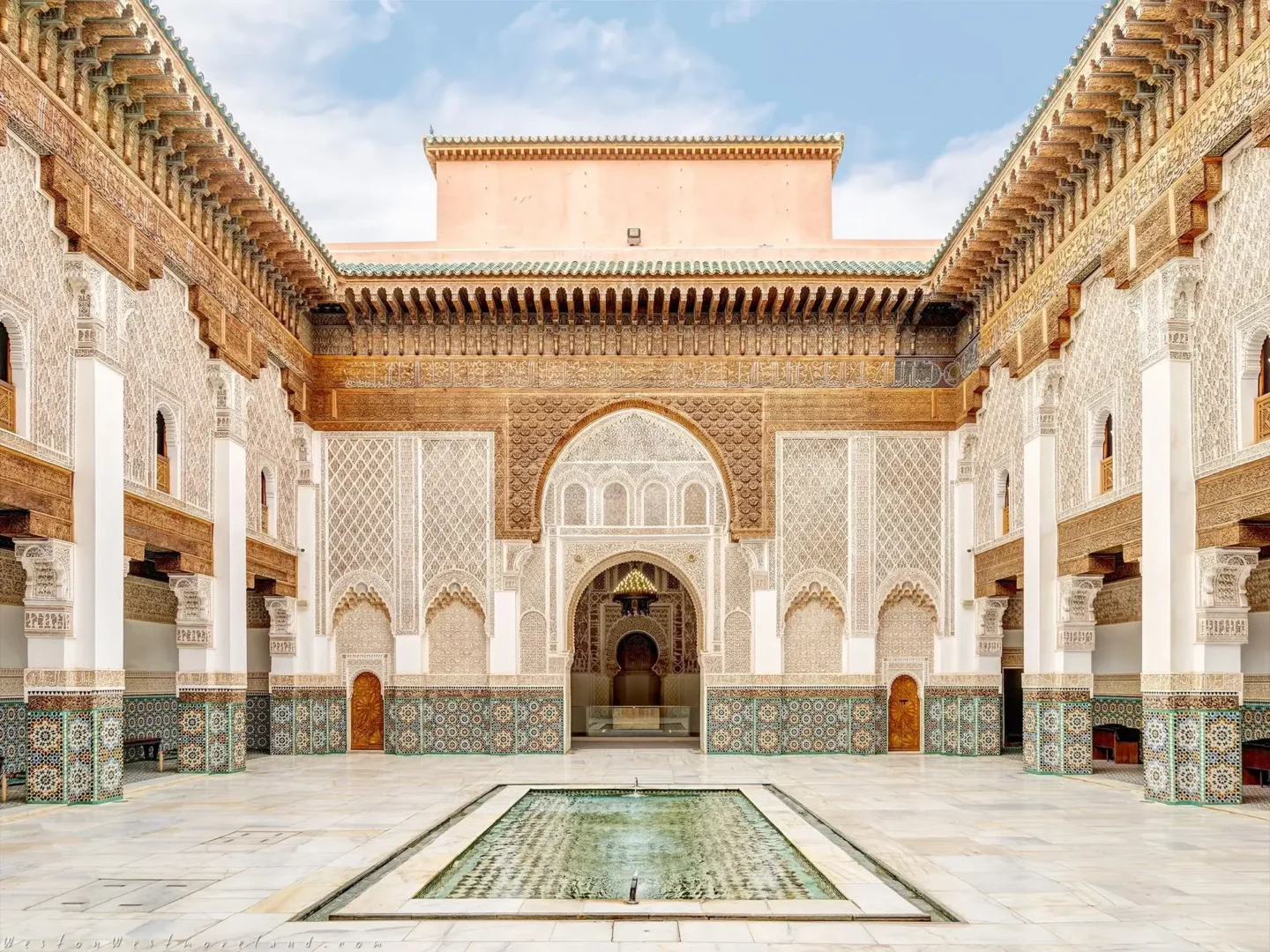
- 3. The Courtyard of Ben Youssef Madrasa
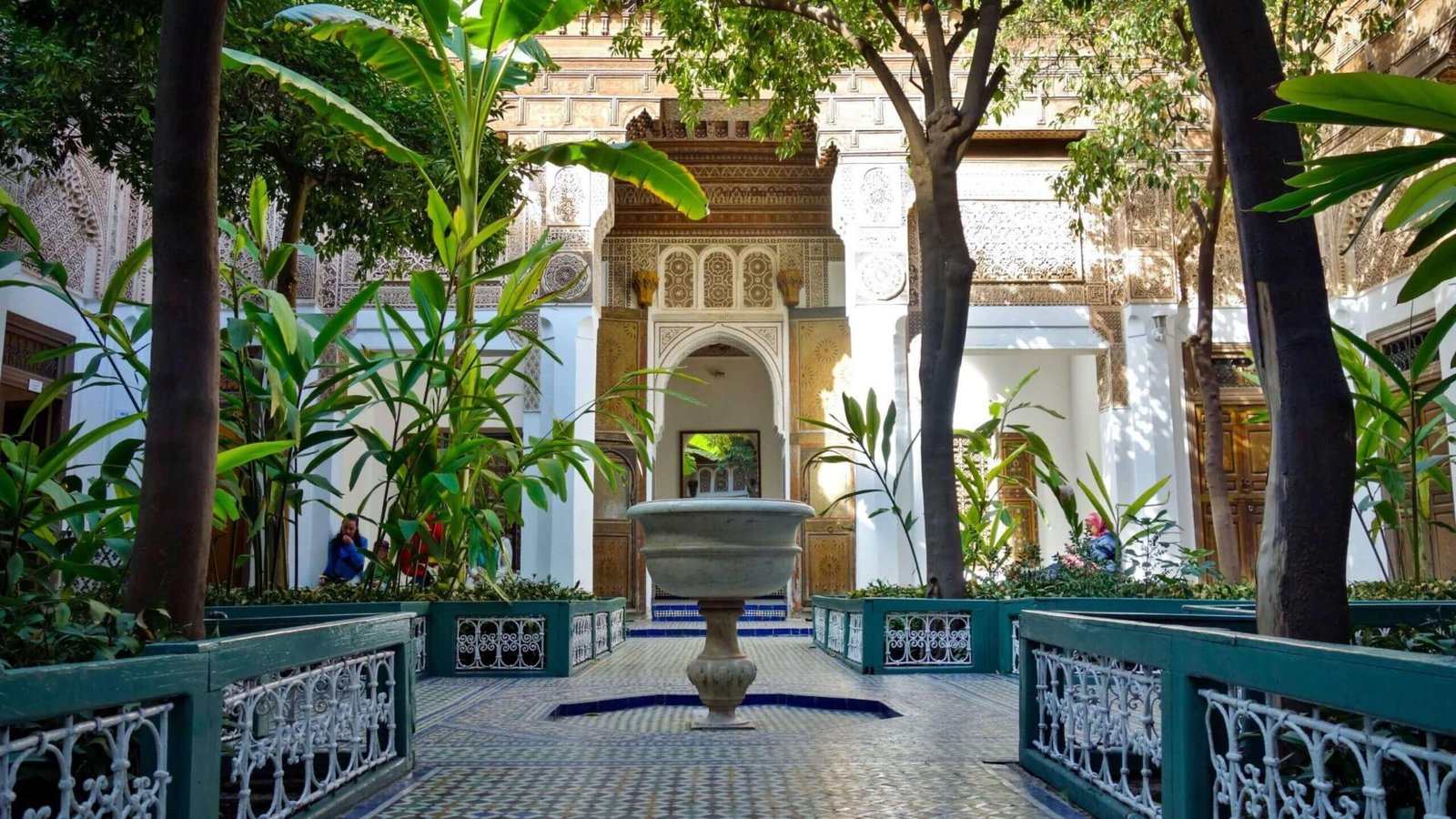
- 4. Bahia Palace Courtyards
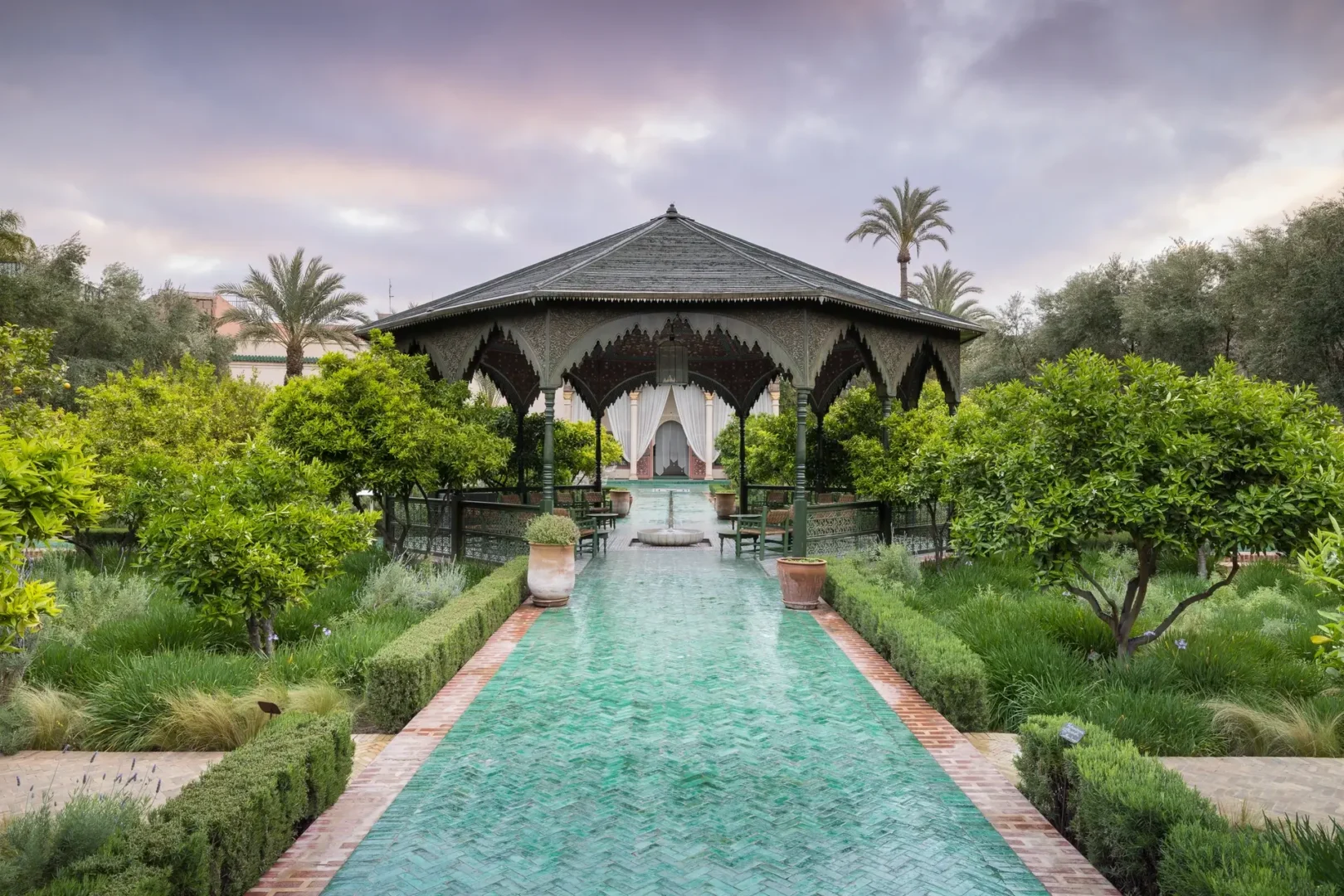
- 5. Le Jardin Secret
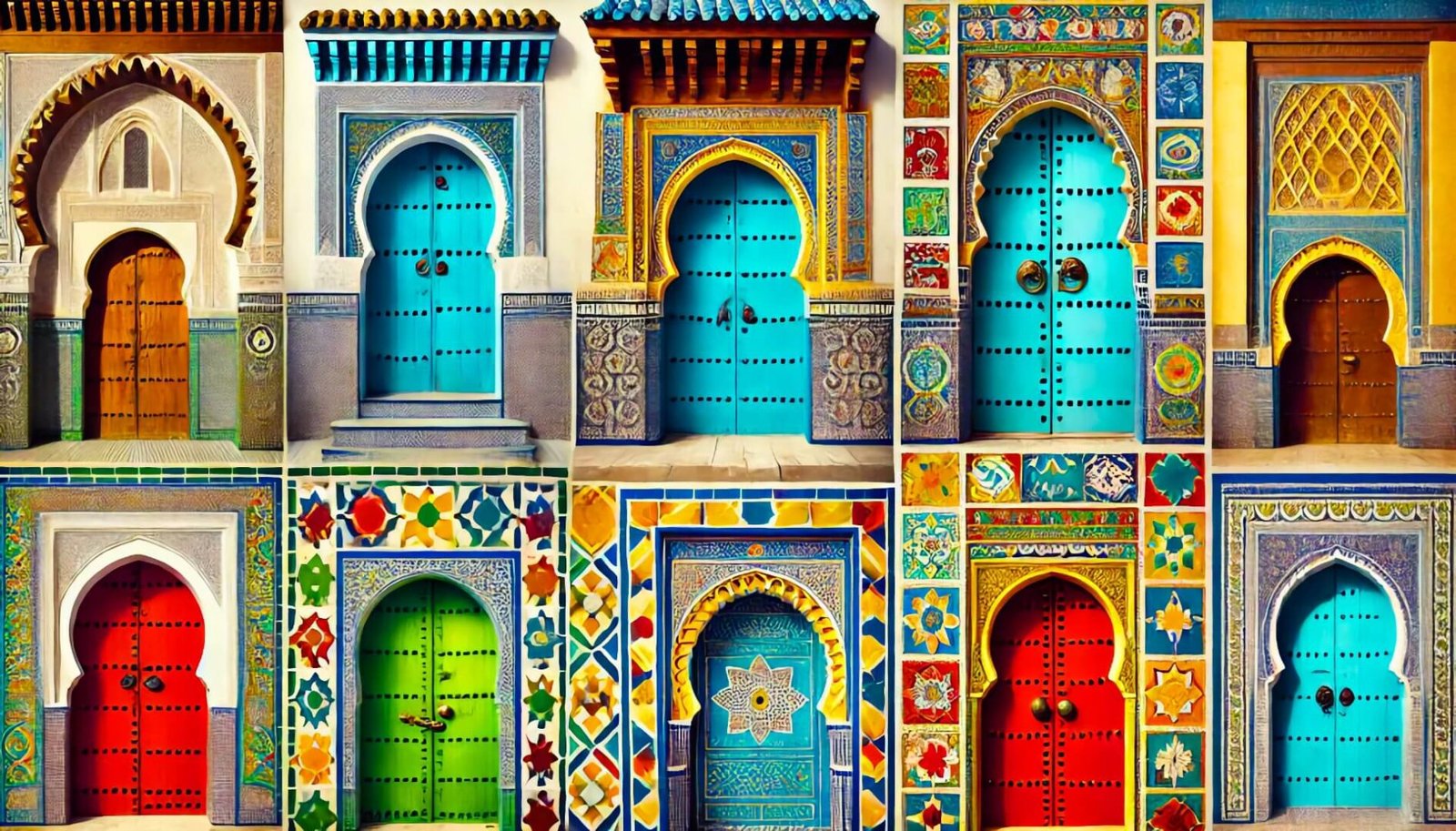
- 6. Colorful Doors of the Medina
- 7. The Souks of the Medina
- 8. Traditional Riad Courtyards
- 9. Koutoubia Mosque Gardens
- 10. Agafay Desert Landscapes
- 11. Palmeraie Palm Groves
- 12. Rooftop Cafés Over the Medina
- 13. Moroccan Carpet Shops
- 14. Hidden Medina Alleys
- 15. Atlas Mountains Viewpoints
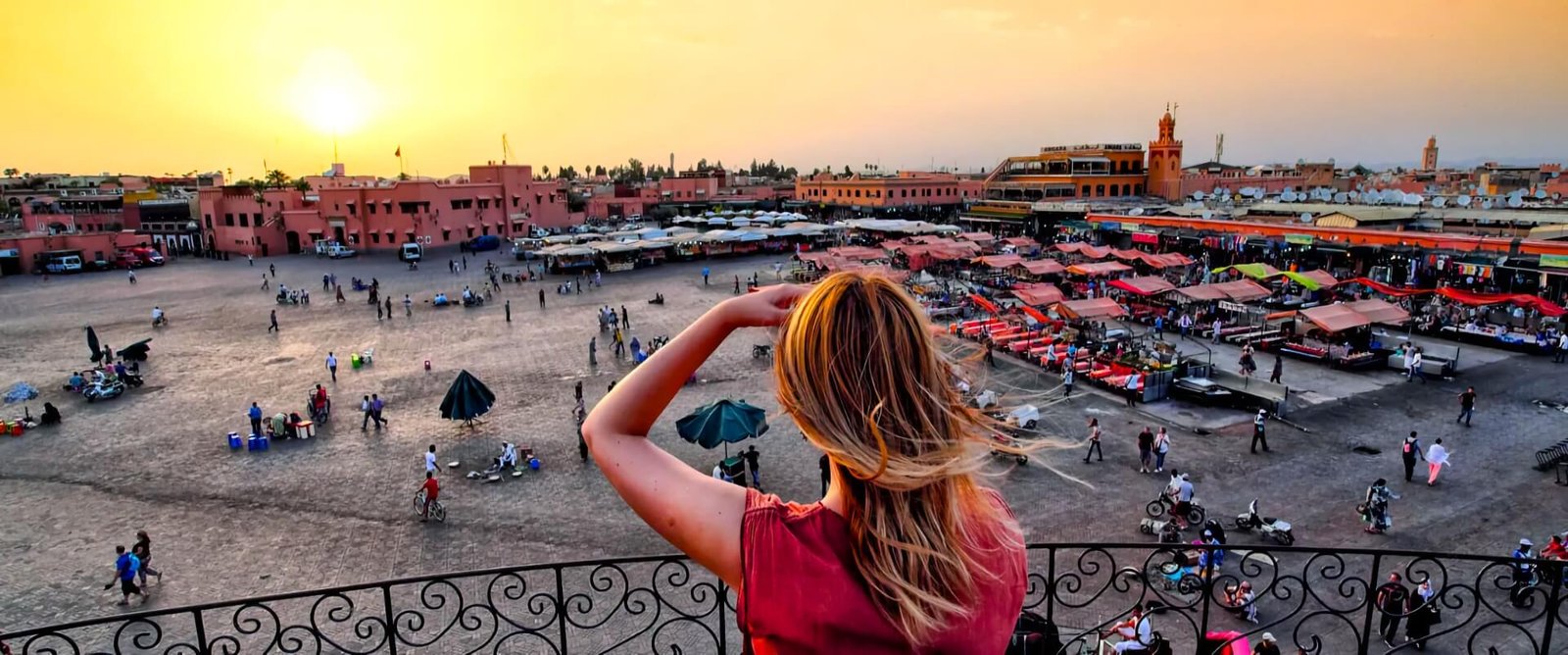
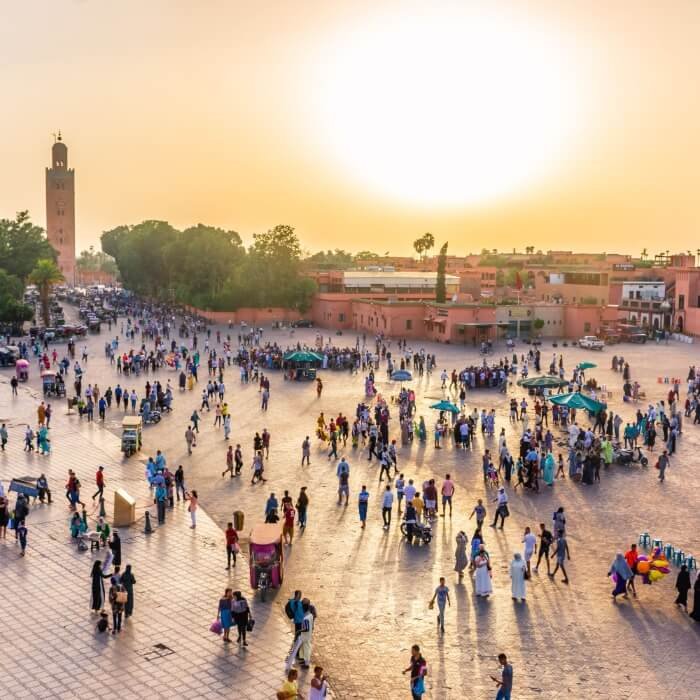
Jemaa el-Fna at sunset — the rooftop view lasts twenty minutes at its best: food stall smoke rising, the Koutoubia catching the last light, the whole city shifting into evening at once
Why Marrakech Is One of the Most Photogenic Cities in the World
Three things make Marrakech unusually rewarding for photography.
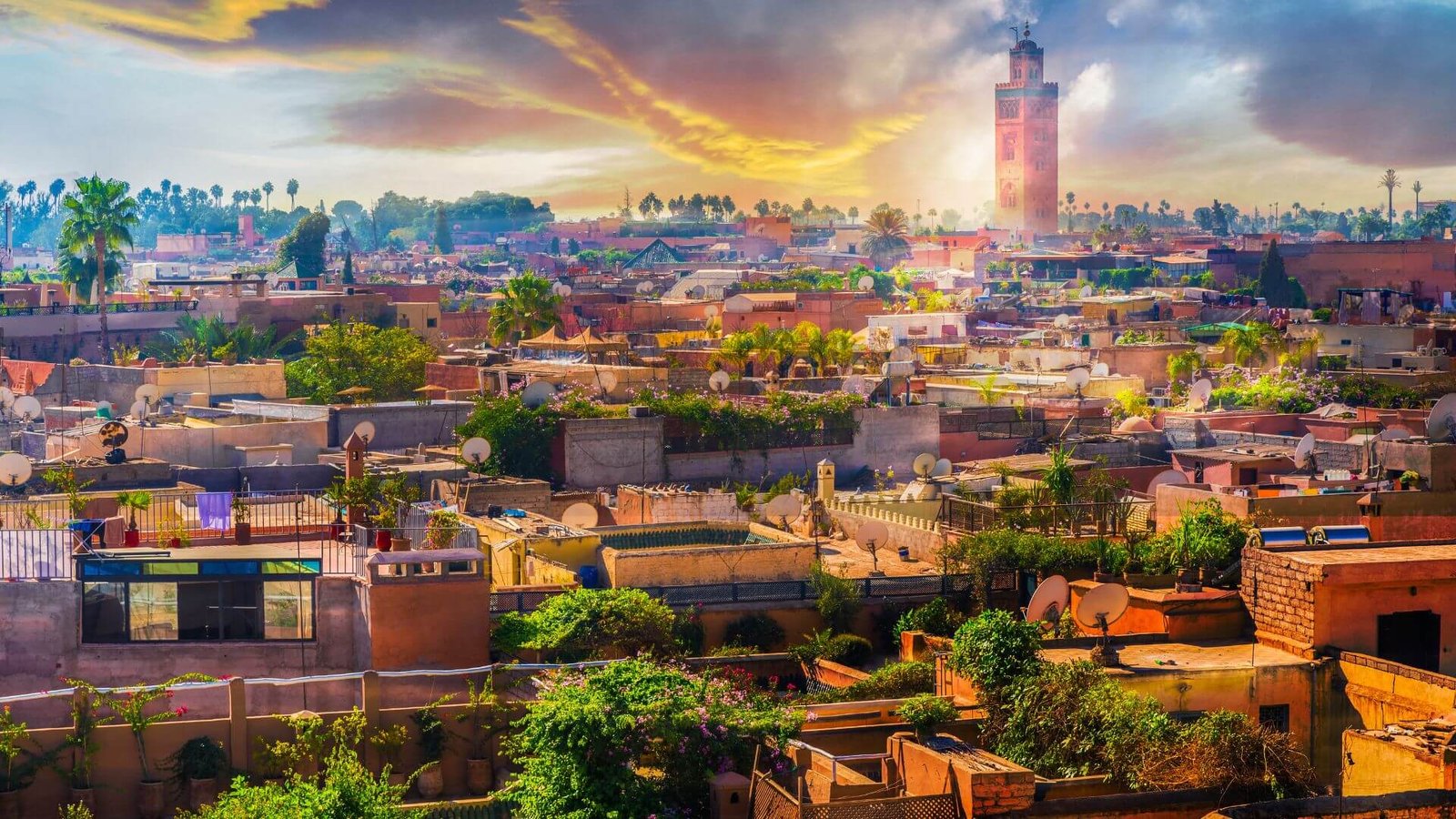
The first is light. Marrakech sits on the desert edge and the light here is distinctive — clear, warm, and directional in the early morning, dramatic and golden in the late afternoon, with almost no grey-sky days. The narrow alleys of the Medina create specific light effects at specific times: a shaft of morning sun striking the floor of a covered souk, a completely shaded riad courtyard at midday, the entire city glowing amber for twenty minutes around sunset.
The second is architecture. The medina is built from materials — terracotta, carved cedar, painted plaster, geometric zellige — that respond well to camera sensors in a way that modern concrete and glass don’t. The patterns are strong and the surfaces are textured. The symmetry of a riad courtyard or a madrasa’s central pool produces compositions that require almost no work.
The third is proximity. The contrast between the Medina’s enclosed market streets and the open landscape of the Agafay Desert thirty minutes south, or the palmerie to the north, means you can photograph genuinely different environments in a single day without significant travel.
15 Best Photography Spots in Marrakech
The spots below were selected because they consistently deliver strong photographic material across different conditions, skill levels, and equipment. Each works for a smartphone; each also rewards a camera with a wider aperture and more control.
1. Rooftop Views Over Jemaa el-Fnaa
The square itself is difficult to photograph from ground level — too much movement, no clear depth. The rooftop perspective changes this entirely. From the cafés and restaurant terraces that ring the square, the organized chaos of Jemaa el-Fna becomes readable: food stall smoke rising in columns, the scale of the crowd visible, the Koutoubia minaret rising to the west as the sky changes color behind it.
The transition from afternoon to evening — roughly 6–7pm depending on season — produces the most interesting light. The sky hasn’t gone dark yet, the food stalls are lit, and the minaret catches the last direct sun. Both natural and artificial light are present simultaneously, which is difficult to replicate at any other time.
Photo tip: Arrive an hour before sunset and find your position before the light becomes interesting. Once it does, it moves fast — fifteen to twenty minutes of the best conditions.
Best time: Sunset and the first thirty minutes of dusk.
2. Jardin Majorelle's Iconic Blue Walls
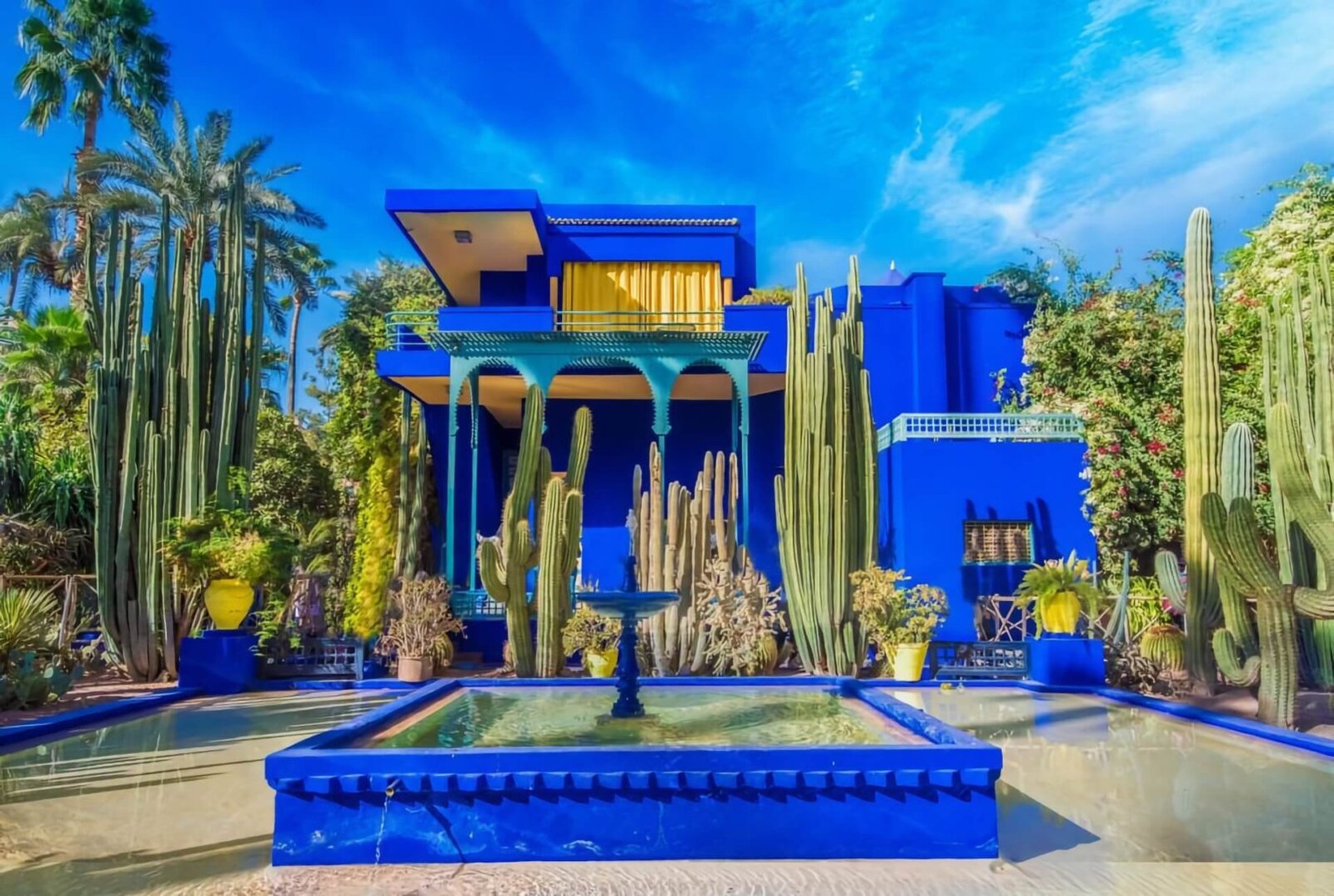
The most photographed garden in Morocco and one of the most photographed in the world. The cobalt blue that Jacques Majorelle used on the structures — a specific intense shade now sold internationally as Majorelle Blue — is genuinely unusual, and the contrast with the dense subtropical planting creates color combinations that don’t occur in many other places. The challenge is the crowds: Majorelle Garden is busy from mid-morning onward and the photography experience degrades significantly once the main paths are full.
The botanical collection itself — over 300 species, including enormous cacti, bamboo, and tropical specimens — provides strong foreground material independent of the blue structures. The Musée Berbère inside is included with the ticket and worth photographing for its interior light.
Photo tip: Look for angles where the blue walls frame rather than fill the frame — a cactus in the foreground against the blue, or a reflective pool showing the blue and the surrounding greenery together.
Best time: First thirty minutes after opening. Book tickets in advance.
3. The Courtyard of Ben Youssef Madrasa
The finest piece of Moroccan-Andalusian architecture in Marrakech and one of the strongest interior photography subjects in North Africa. The central courtyard’s logic — marble pool at center reflecting the carved stucco and cedar above, zellige tilework on the lower walls, upper student balconies framing the sky — produces symmetrical compositions that are almost self-composing. Every serious axis through the space works as a photograph.
The upper level is underused by visitors and provides the best overview of the courtyard geometry. The morning light enters from the open roof and creates a raking light across the stucco carvings that flattens by midday.
Photo tip: The reflection in the central pool works best when the water is undisturbed — arrive at opening before other visitors have passed by it. The upper balconies for a top-down view require more patience but produce less common images.
Best time: Opening time, first hour only.
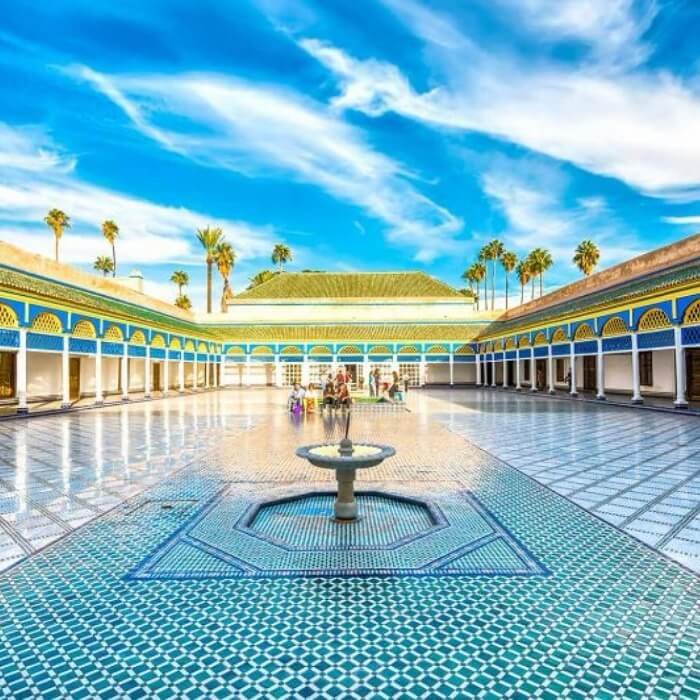
4. Bahia Palace Courtyards
Where Ben Youssef Madrasa rewards precision and symmetry, Bahia Palace rewards space and the quality of Moroccan decorative surface work. The main courtyard gives you enough room to step back and capture the full scale of the architecture — something the tight alleys of the Medina rarely allow. The carved cedar ceilings, painted archways, and zellige floors photograph well throughout the palace but particularly in the harem courtyard, which receives the most complex light.
The light shifts considerably through the day as the sun moves over the open roofs. Mid-morning in the main courtyard; late afternoon in the smaller side rooms where the angled light picks up the surface decoration best.
Photo tip: The tiled floors include strong geometric patterns that work as leading lines toward the architecture. Include them in the foreground of courtyard shots.
Best time: Arrive at opening for the main courtyard; return to the smaller rooms late afternoon.
5. Le Jardin Secret
The least-visited major photography location in the Medina, which is its primary advantage. Le Jardin Secret is usually quiet enough to compose shots without strangers walking through the frame — something that’s genuinely rare anywhere near the main souk circuit. The Islamic garden’s four-part layout with central fountain and symmetrical pathways, and the exotic garden’s more informal subtropical planting, offer two different visual registers in one small space.
The tower viewpoint is the page’s standout image — an elevated rooftop view over the northern Medina that most visitors to Marrakech never see.
Photo tip: The central fountain in the Islamic garden produces clean symmetrical reflections in mid-morning when the sun is high enough to illuminate the pool but before it bleaches the color from the tiles.
Best time: Mid-morning, on days when the garden is not hosting events.
6. Colorful Doors of the Medina
Not a single location but a practice — the specific habit of photographing in the residential quarters of the Medina rather than the commercial souk streets. The doors here (emerald green, deep blue, ochre, faded turquoise, carved wood against painted plaster) are not curated for visitors; they’re simply how the buildings look. That incidental quality is what makes them worth photographing.
The best door photography in the Medina happens in the Mouassine quarter, the Kennaria area, and the quieter streets south of the Bahia Palace toward the Kasbah. These are working residential neighborhoods; approach them with the discretion that implies.
Photo tip: The relationship between the door and the wall around it — the framing, the color contrast, the texture — matters more than the door alone. A simple door in a beautifully aged wall is more interesting than an ornate door in a recently rendered one.
Best time: Early morning, when the light is raking and soft and the streets are empty.
7. The Souks of the Medina
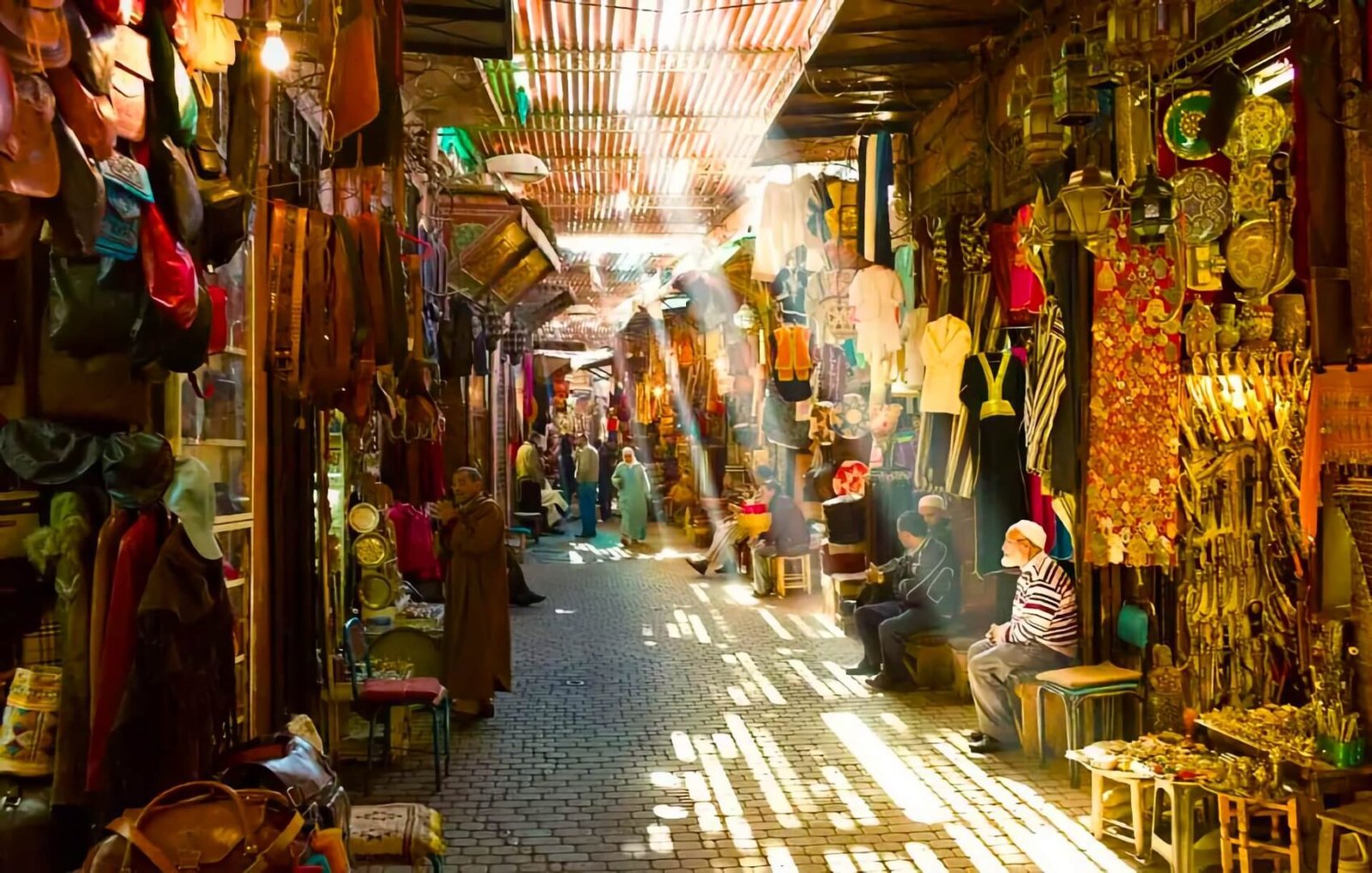
The souks are challenging to photograph well because they’re densely chaotic and the light is unpredictable. The covered sections of Souk Semmarine have strong overhead slats that create dramatic light patterns at certain times but deep shadow at others. The open sections — particularly the spice market around Rahba Kedima and the Souk des Teinturiers — have more consistent and workable light.
The Souk des Teinturiers (dyers’ souk) near the Mouassine quarter is the single most photogenic section of the entire souk system: fresh-dyed wool skeins hanging across the alleys in vivid reds, yellows, and blues, with the dyeing vats visible below. It requires navigating away from the main tourist circuit but rewards the effort with images that are genuinely different from everything else in the souks.
Photo tip: In the covered souks, look for the moments when a shaft of light from the overhead lattice falls directly on a display. These last seconds and create the most dramatic souk images. For the dyers’ souk, mid-morning when the wool is freshly hung and drying.
Best time: Morning before 10am for Souk Semmarine; mid-morning for the dyers’ souk.
Powered by GetYourGuide
8. Traditional Riad Courtyards
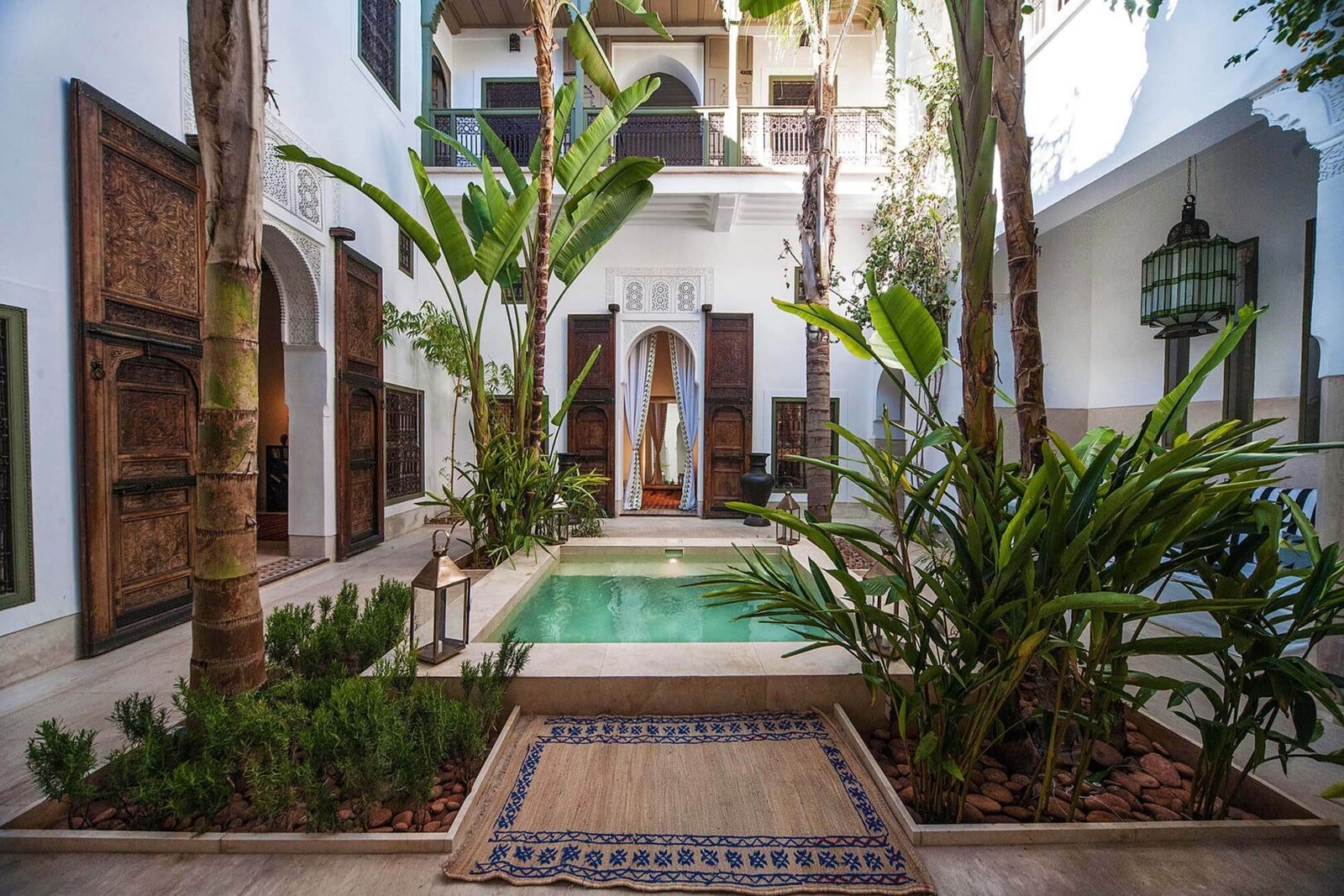
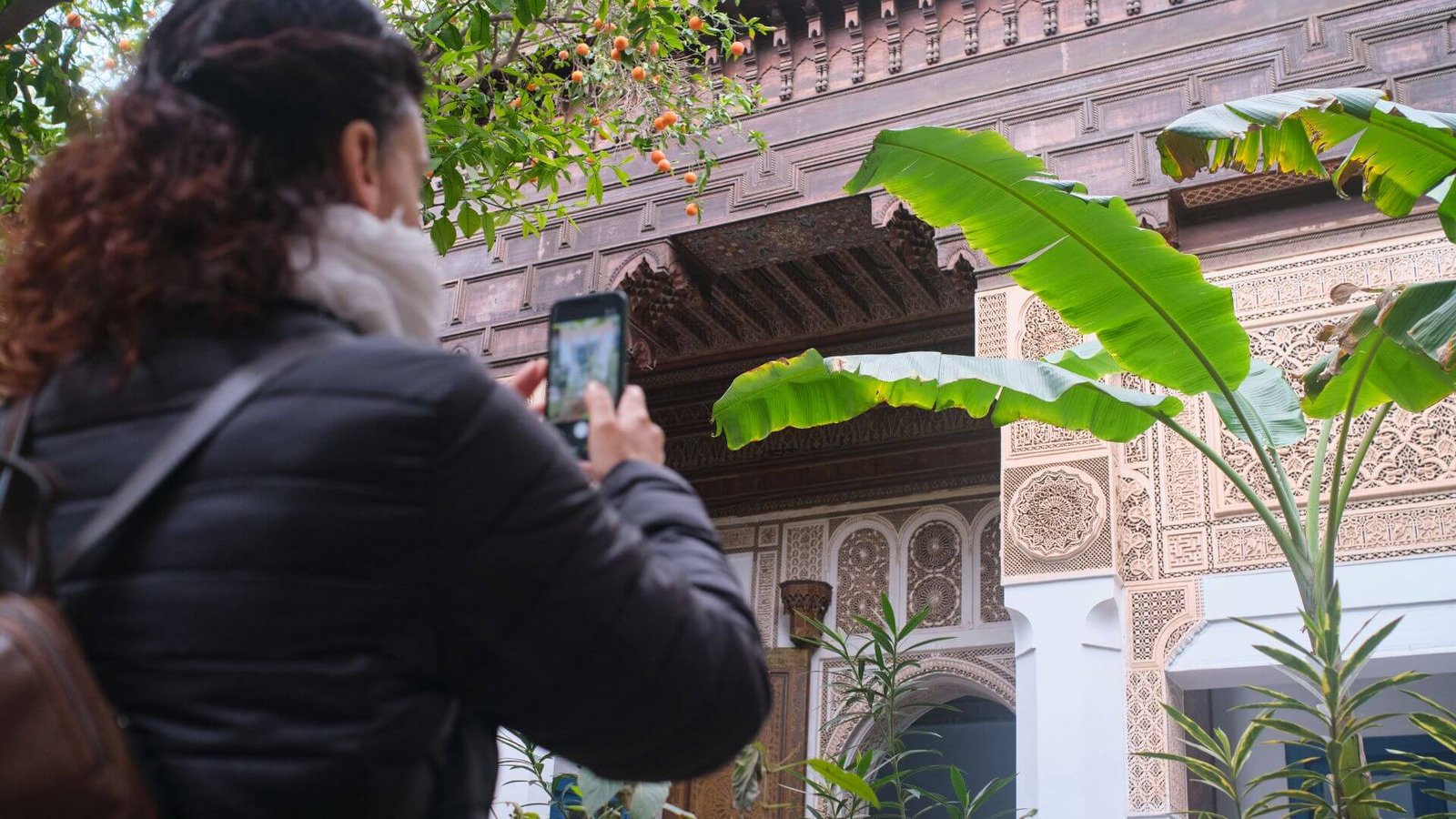
The riad courtyard is the defining architectural image of Marrakech — the thing that makes the city visually distinctive from any other. A central fountain, zellige tilework, carved plaster, a lemon tree, light falling through the open roof onto the patterned floor: the formula is consistent and consistently beautiful. The challenge is access, since riads are private properties.
The most reliable approach: stay in a riad with a good courtyard (the photography benefit is worth factoring into accommodation choice), book tea in a riad known for its interior, or book a cooking class that includes courtyard access. Several high-end riads also offer specific photography access.
Photo tip: The reflective pool at the center of many riad courtyards produces the cleanest images when the water is still — early morning before other guests pass through. The light from directly overhead creates the most even illumination on the floor patterns.
Best time: Early morning or midday when the sun is directly overhead and enters the courtyard.
Internal links: Luxury Riads , Boutique Riads , Budget Riads
9. Koutoubia Mosque Gardens
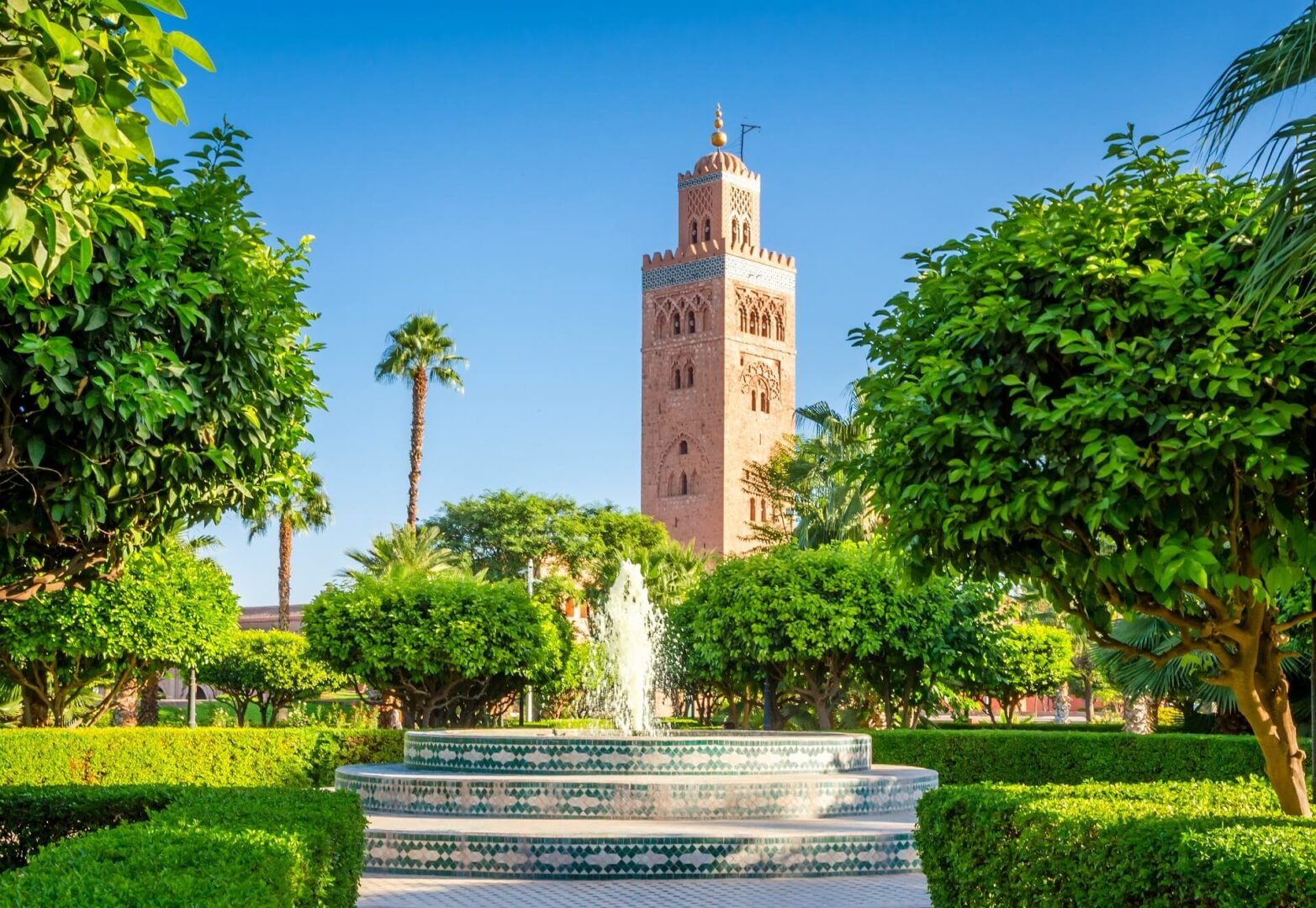
The Koutoubia minaret is Marrakech’s most recognizable structure and the most straightforward major photography subject in the city — it’s large, it’s well-lit, and it’s accessible from multiple angles. The gardens to the north of the mosque, away from the main Jemaa el-Fna approach, are the least visited section and provide the most relaxed photography environment. The minaret in late afternoon light, with the gardens and palm trees in the foreground and the Atlas Mountains visible on clear days behind it, is one of the city’s classic compositions.
The western side of the gardens provides the best light on the minaret from approximately 3pm onward. The call to prayer five times daily adds an atmospheric audio dimension that changes the experience of the location significantly.
Photo tip: Frame the minaret with the palm trees on either side for a classic composition, or use the garden pathways as a leading line toward it. The minaret is lit after dark and produces good long-exposure images.
Best time: Late afternoon, from about 3pm to sunset.
10. Agafay Desert Landscapes
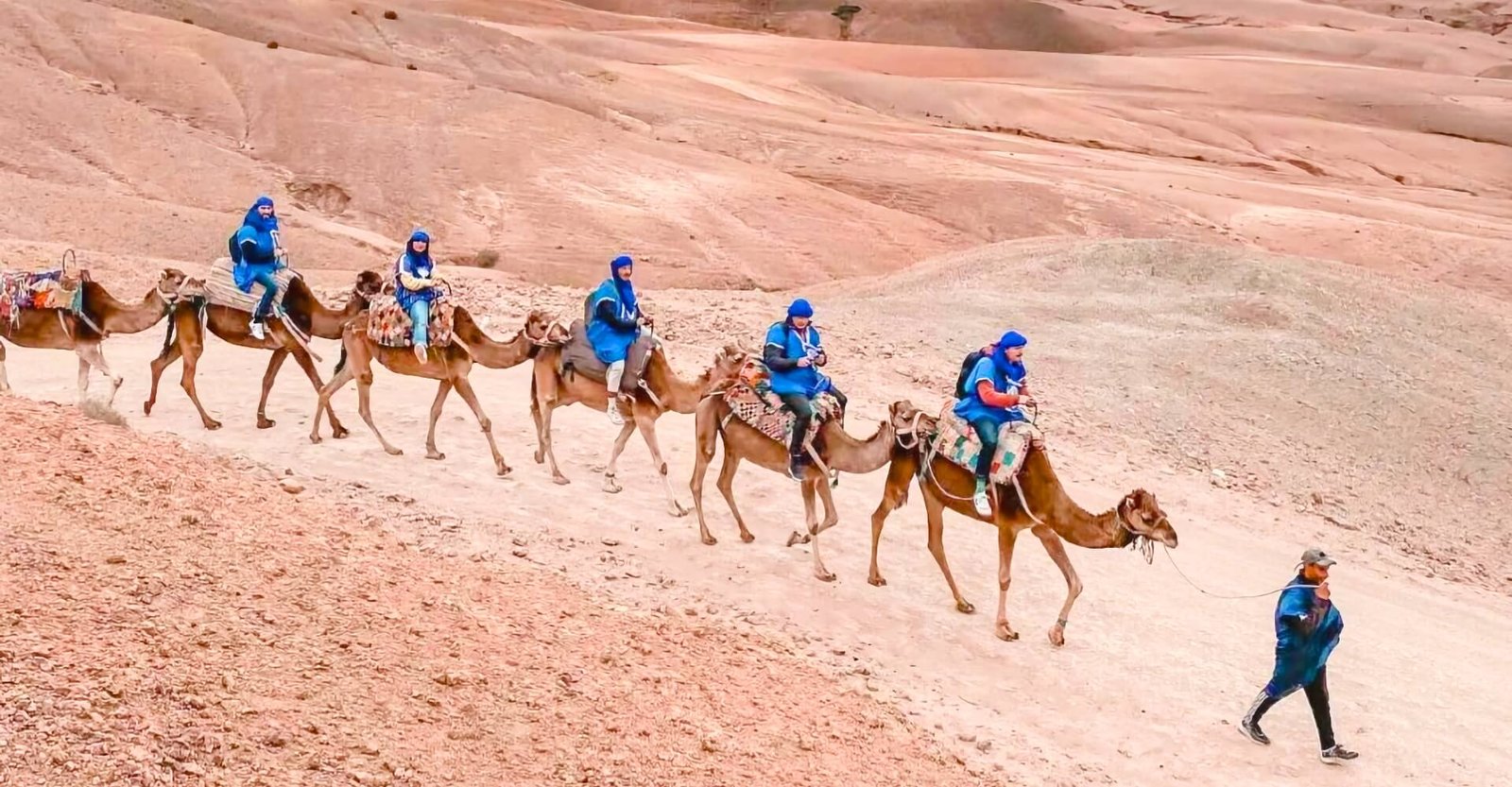
Thirty minutes south of Marrakech, the Agafay is a rocky plateau that looks entirely different from the Medina and entirely different from any desert you might have imagined. There are no dunes — instead, a vast expanse of grey-ochre rock and sparse vegetation stretching toward the High Atlas foothills. The scale is enormous and the sky is correspondingly large.
The quality of light here in the early morning and late afternoon is extraordinary — the low sun rakes across the rock surface creating texture and shadow that midday flattens completely. Camel silhouettes against a sunset sky over the Agafay is one of the most reproducible dramatic images available near Marrakech.
Photo tip: Low angles emphasize the rocky texture of the terrain and maximize sky. A wide-angle lens or the widest option on your phone captures the scale. Silhouettes of camels, quad bikes, or lone figures at golden hour require no technique — the light does the work.
Best time: Sunrise or the final two hours before sunset.
Internal links: Desert Quad Biking , Camel Ride
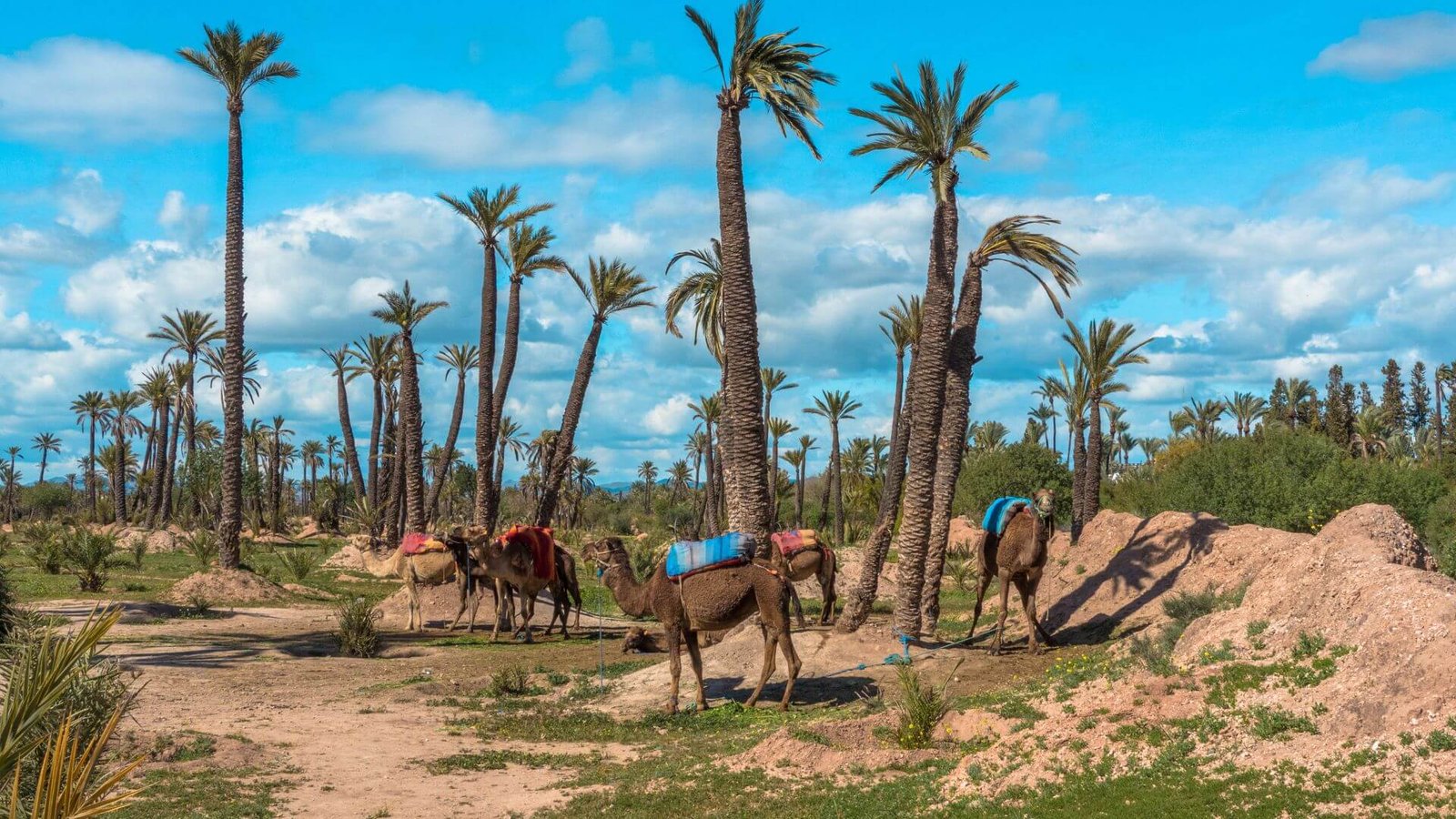
11. Palmeraie Palm Groves
The Palmeraie north of Marrakech is a palm oasis of approximately 13,000 trees that has been here since the medieval period. The trees are tall, the light filters through the fronds in specific ways depending on time of day, and the contrast between the dense planting and the open sky above creates strong vertical compositions that photograph differently from anything in the Medina.
The most effective Palmeraie images use the rows of palms as leading lines — the perspective compression of a longer focal length working well here — often with a camel, a rider, or a single figure at the vanishing point.
Photo tip: The light through the fronds is best in the two hours after sunrise and two hours before sunset. The Palmeraie at midday loses most of its visual interest.
Best time: Early morning or late afternoon.
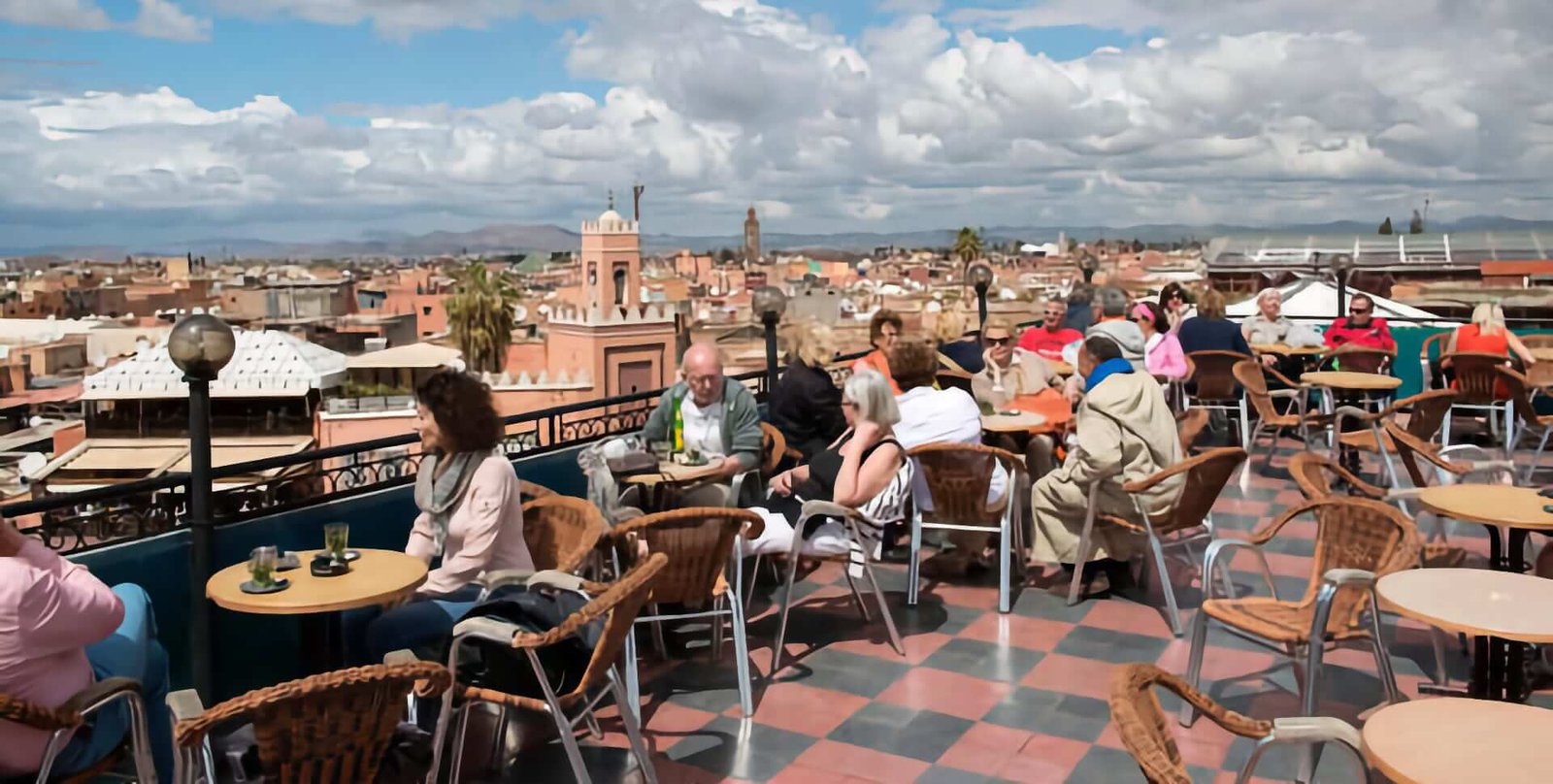
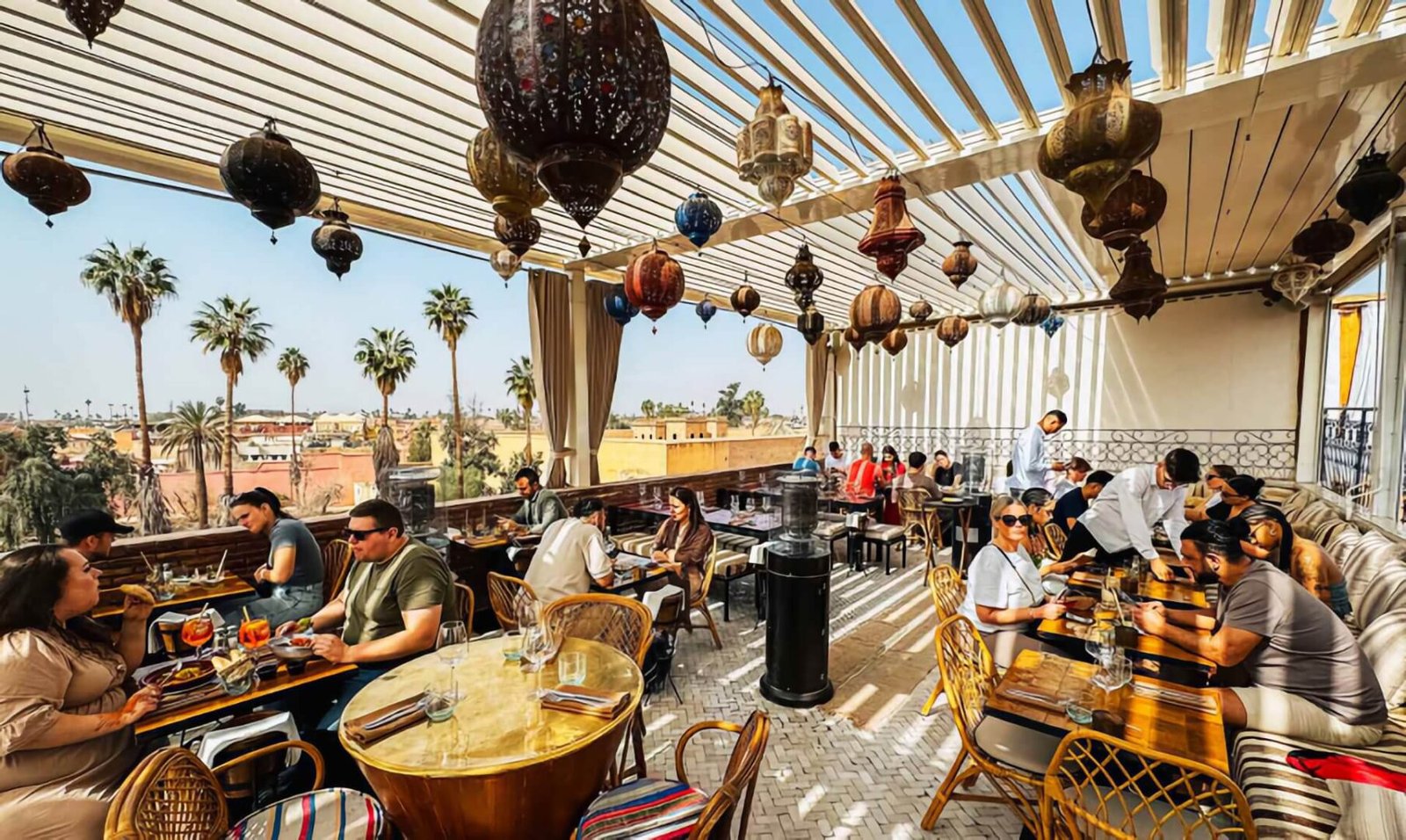
12. Rooftop Cafés Over the Medina
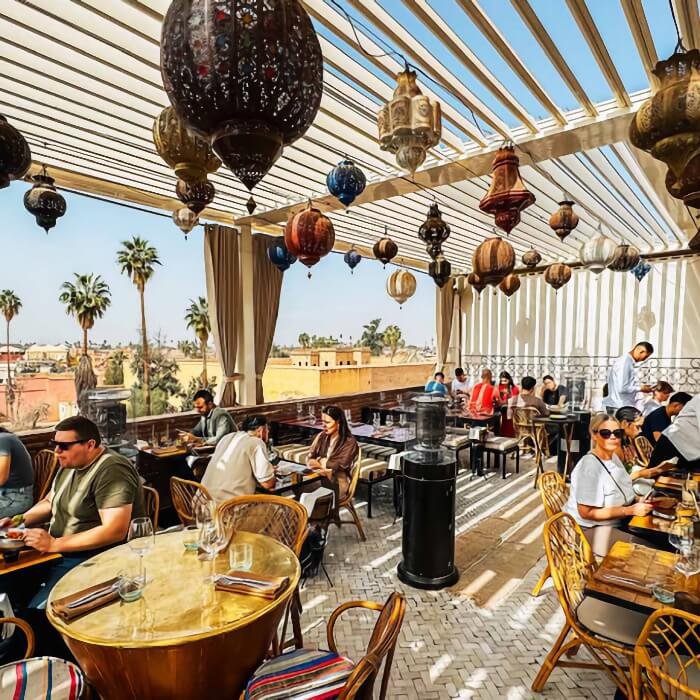
The rooftop view over the Medina is one of the defining Marrakech images — terracotta rooftops stretching in every direction, punctuated by minarets, with the Atlas Mountains on the horizon and the sky above changing color. The best rooftop photography locations are the ones with the least obstructed view and a good relationship between foreground interest (café furniture, lanterns, a section of decorated parapet) and the cityscape behind.
Café de France on Jemaa el-Fna is the most accessible rooftop view; Café des Épices in the souk district offers a view over the northern Medina that includes minarets and market rooftops at closer range. Both have better photography conditions than most of the purpose-marketed rooftop experiences.
Photo tip: Include something in the foreground — a tea glass, a lantern, a potted plant — to give scale to the cityscape behind it. Without foreground interest, rooftop shots of Marrakech tend to read as flat.
Best time: Late afternoon to sunset.
Internal links: Rooftop Restaurants
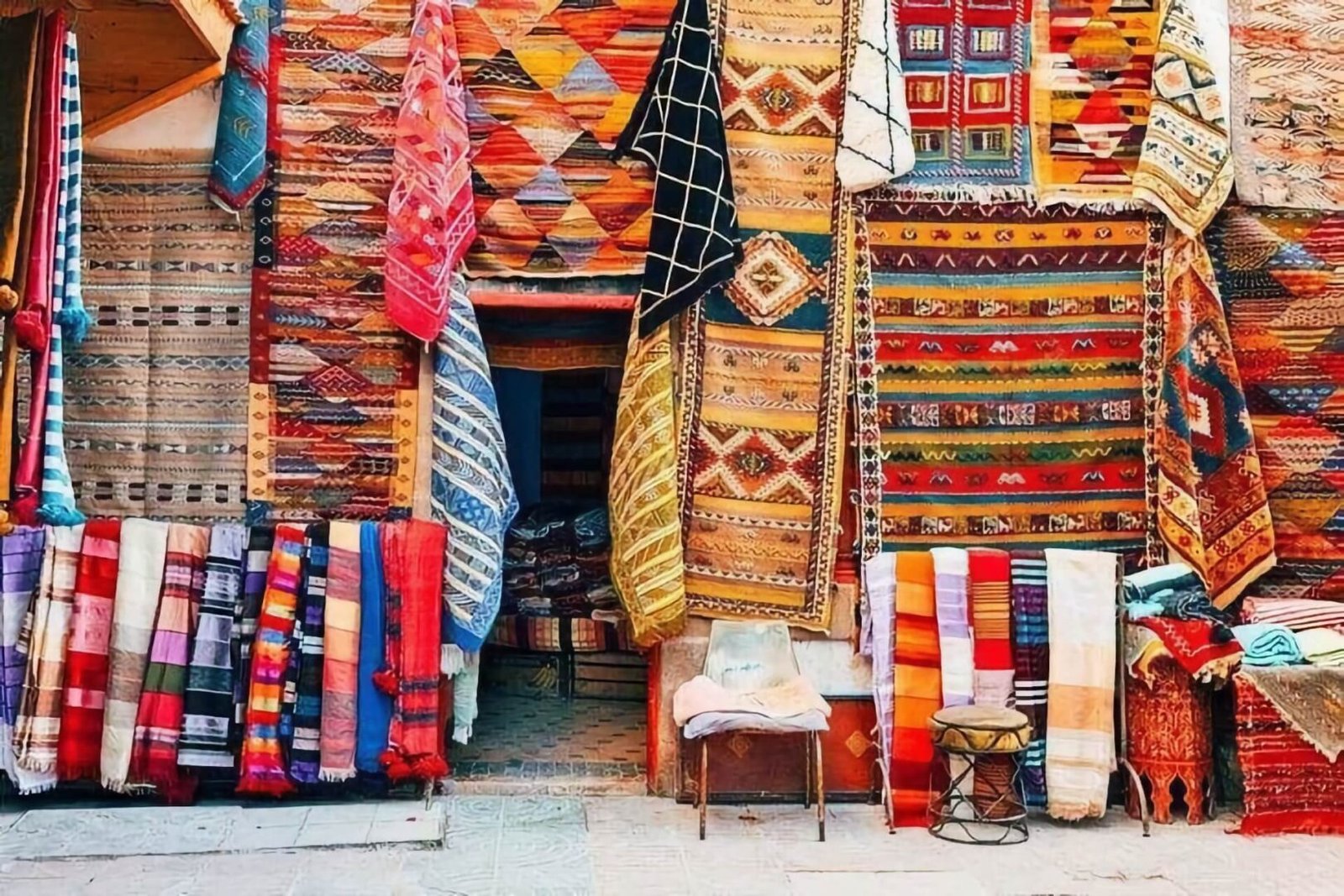
13. Moroccan Carpet Shops
The carpet shops of the Medina — particularly the dedicated carpet merchants in the northern souk district and around Rahba Kedima — offer visual material that doesn’t exist in the same way anywhere else: stacks of handwoven rugs in every pattern and color, hanging vertically from ceiling to floor, creating layered tapestries of texture and color that reward close inspection and wide shots equally.
The challenge is navigating the commercial dynamic: entering a carpet shop to photograph usually implies interest in buying, and the sales process is persistent. Being honest about your intention to photograph rather than buy, and being genuinely courteous about it, generally works. Alternatively, purchase one small item to establish goodwill.
Photo tip: The stacked rugs create depth — use this vertically by photographing from low down looking up, or include the shopkeeper in the frame to add scale and human context.
Best time: Mid-morning when the natural light from the alley entrance reaches furthest into the shop.
14. Hidden Medina Alleys
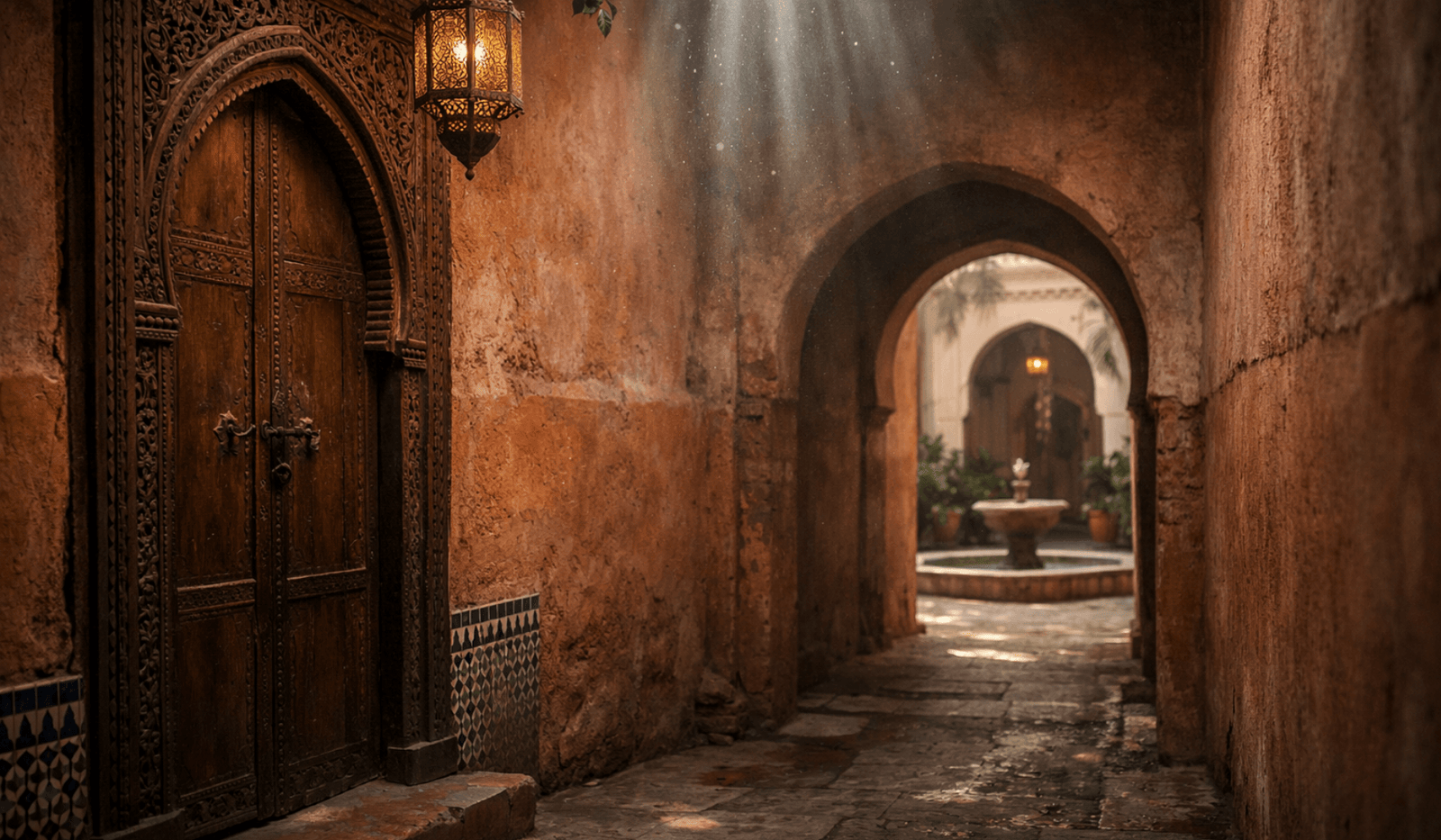
The residential quarters of the Medina — particularly the Mouassine, Kennaria, and Riad Zitoun areas — contain streets that see almost no tourist traffic and look exactly as they have for generations: pale ochre walls, occasional painted doors, cats on steps, a shaft of light crossing a narrow alley floor. These are the least curated and most genuinely atmospheric photographs available in Marrakech.
The trick is navigation — these quarters are genuinely easy to get lost in and genuinely rewarding when you do. A walking route from the Mouassine mosque south through the residential lanes toward the Bahia Palace passes through approximately thirty minutes of this material.
Photo tip: Shoot with available light only — no flash. The incidental quality of these alleys is destroyed by any artificial illumination. Look for light falling on a specific wall or doorway rather than trying to photograph the whole alley.
Best time: Early morning when the light is raking and no one is yet about.
Internal links: Hidden Gems
15. Atlas Mountains Viewpoints
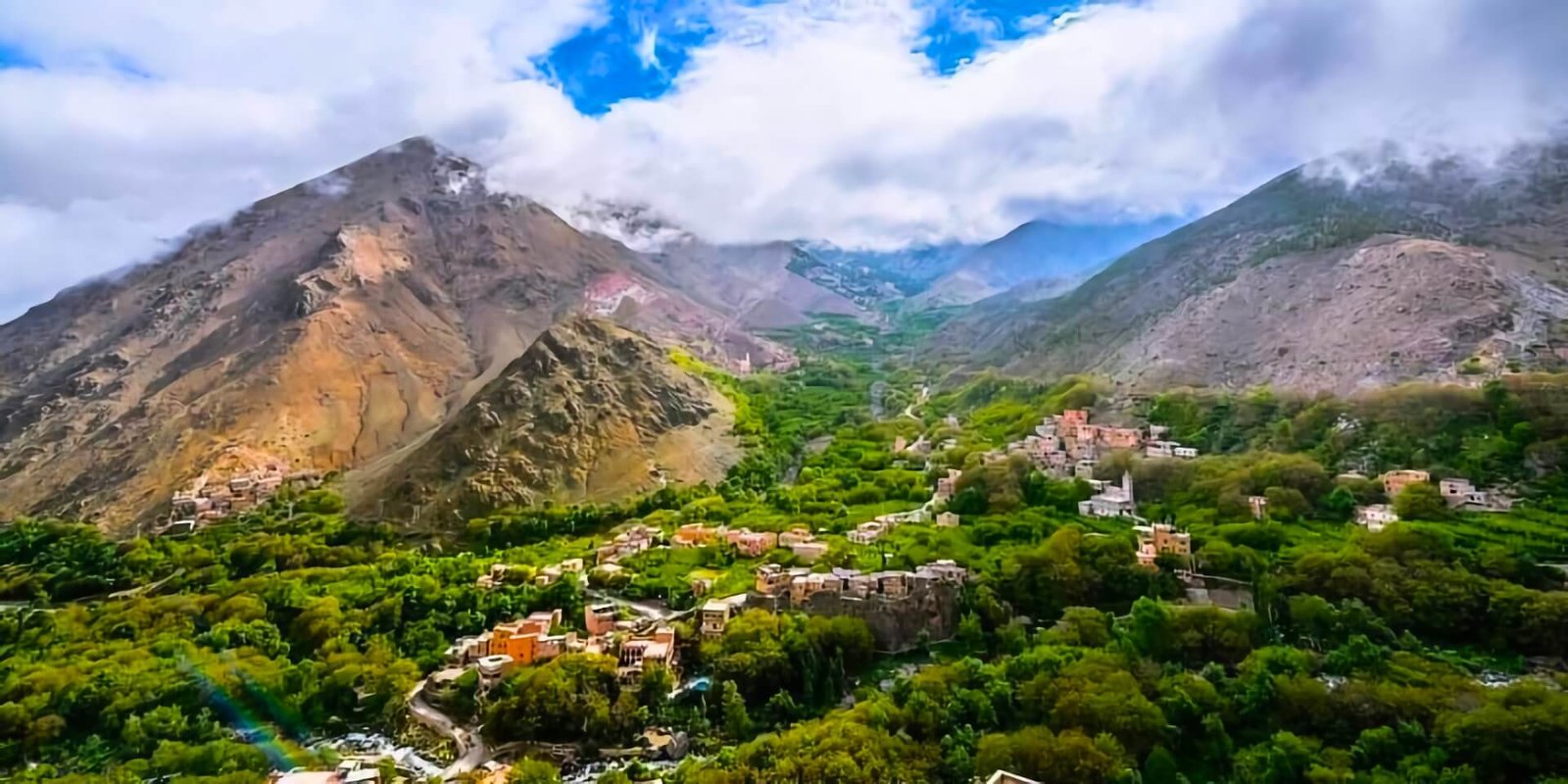
The Atlas Mountains are visible from Marrakech on clear days — from rooftops in the Medina, from the Menara Gardens pavilion, from the elevated terraces of El Badi Palace — and from the Agafay Desert they dominate the northern horizon. In winter and spring, snow on the peaks adds a visual element that dramatically changes the character of the view.
The clearest views are in the morning before the heat haze builds. After rain is usually the best time — the air clears completely and the mountains appear much closer and more detailed than on a standard day. The drive into the Atlas foothills (Ourika Valley, Asni, Imlil) takes under an hour and provides progressively more dramatic photographic territory.
Photo tip: Use the Menara Gardens pavilion and reflecting pool to frame the mountains — the pavilion-pool-mountains composition is one of the most classic views in Marrakech. The mountains are best photographed in the morning.
Best time: Morning on a clear day, especially after rain. Winter and spring for snow on the peaks.
Internal links: Atlas Mountains Day Trip
Best Time of Day for Photos in Marrakech
Early morning (6–9am) — the best time for the Medina’s interior spaces (madrasa, riad courtyards, the dyers’ souk), for the residential alleys, and for Majorelle Garden. The light is soft and warm, the streets are empty, and the quality of the atmosphere is entirely different from what the same places offer at 11am.
Late afternoon / golden hour (4–6pm depending on season) — the best time for exterior and rooftop photography. The Koutoubia, Jemaa el-Fna, the Agafay Desert, and the Palmeraie all perform at their best in the last two hours of direct sun. The city’s terracotta goes genuinely golden and holds that for thirty to forty minutes.
Midday — useful for the patterns and textures in the covered souks, where overhead light creates specific effects. Difficult for outdoor photography in summer due to harsh contrast. The deep shade of a riad courtyard at noon, when the sun is directly overhead, can produce beautiful even light on the floor patterns.
Evening — the souks after the lanterns come on, Jemaa el-Fna when the food stalls are fully lit, the Medina lanes with their occasional street lighting. Requires either a steady hand at high ISO or a tripod. The candlelit spaces at Les Bains de Marrakech and similar establishments reward a tripod visit.
Marrakech Photography Tips
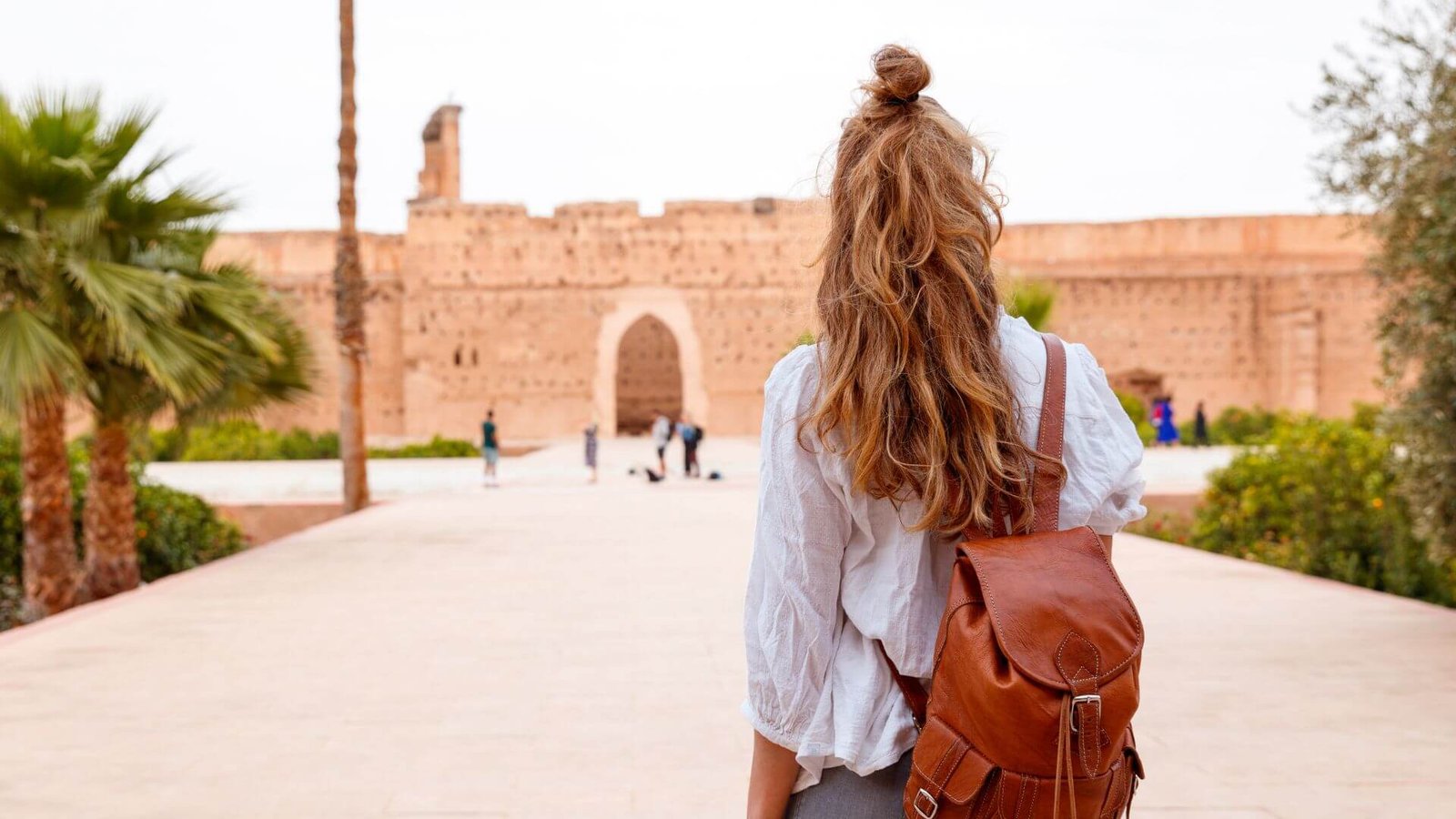
1. Ask before photographing people. The standard in the Medina is to ask permission before photographing individuals, particularly vendors and performers. A phrase in Darija (wash ymkn liya nswwrk? — can I photograph you?) goes further than a smile, but the smile matters too. Paying the subject is expected if they perform for you.
2. Arrive early at the major monuments. Ben Youssef Madrasa, Bahia Palace, and Majorelle Garden are all dramatically better in the first hour after opening. The difference in crowd density and light quality is significant enough to justify the early alarm.
3. Use the architecture as a frame. The Medina’s arched doorways, latticed windows, and carved plaster screens create natural frames within frames. Include them rather than trying to shoot past them.
4. Get close to the surfaces. Moroccan zellige, carved stucco, and woven textiles reward close examination. The detail work in Ben Youssef Madrasa alone provides an hour of close-up material.
5. Plan around the light, not the location. Decide what quality of light you want and then choose the location accordingly — rather than going where you planned to go and hoping the light is right.
6. A wide-angle lens covers most situations. The Medina’s tight spaces, the open panoramas of the Agafay, and the verticals of the madrasa courtyard all work with a wide-angle. A 24mm equivalent or wider is the most useful single focal length.
7. Use leading lines deliberately. The Medina provides them constantly — tiled floors, vaulted corridors, palm-lined paths, souk alleyways. Point them toward your subject.
8. The best photographs include one human element. A figure in an alley, a hand on a door, a face behind a spice stall. Marrakech without people is an architectural record; with one person it becomes a story.
Hidden Photography Spots Most Visitors Miss
The 15 spots above cover the most reliable locations. These four are the ones that require more navigation but tend to produce more personal images.
The Chouara Tannery terrace — the view over the leather tannery vats from the rooftops of the surrounding leather shops is one of the most iconic images of Marrakech, but the tannery is not listed as a numbered spot because access is via the leather shops and requires navigating a sales context. The view is extraordinary: dozens of round dye vats in ochre, red, white, and brown, workers standing in them, the whole operation visible from above. Best in the morning when the colors are freshest.
The Saadian Tombs garden — once through the main chamber (which is crowded), the garden surrounding the outer tombs is often empty and genuinely beautiful: orange trees, tiled graves, a quietness that contrasts sharply with what’s just through the wall.
The Mouassine quarter at 7am — the residential streets between the Mouassine mosque and the Souk des Teinturiers before the souks open. Cats, delivery men, shop owners beginning their day, light on walls that will be in deep shadow by 9am.
The Menara Gardens pavilion from the east bank of the pool — most visitors photograph the pavilion from the path running along the north side. The view from directly across the pool, with the pavilion centered and the Atlas Mountains behind it, is the stronger composition and requires walking around to the opposite bank.
Internal links: Hidden Gems in Marrakech
Related Things to Do in Marrakech
-

Attractions
The full guide to Marrakech's major sites — with honest timing advice that applies equally to photography.
-
Hidden Gems
The less-visited locations that produce the most personal photographs.
-
Top 20 Things to Do
The full Marrakech experience list, with the photography-relevant items clearly identifiable.
-
Rooftop Restaurants
The rooftop view combined with a meal. Several of the best photography rooftops are also good restaurants.
-

Atlas Mountains Day Trip
An hour from Marrakech and a completely different photographic register — mountain villages, Berber landscapes, the Atlas itself.
 Marrakist Concierge