It depends on your travel style. First-time visitors are best served by the Medina — it’s central, walkable, and puts you inside the city’s history. Luxury travelers who want resort facilities tend to prefer Hivernage or the Palmeraie. The Kasbah is the best option if you want the Medina’s atmosphere with less noise.
Where to Stay in Marrakech: Best Areas, Riads & Hotels for Every Traveler
Where you sleep in Marrakech shapes everything — not just your comfort, but how the city feels from the moment you open your eyes. Stay inside the ancient Medina and you wake up to birdsong in a riad courtyard, with the souks five minutes’ walk away. Choose Hivernage and your mornings start on a hotel terrace overlooking palm-lined boulevards. Pick the Palmeraie and Marrakech becomes a backdrop rather than an immersion.
None of these is the wrong choice — they’re just very different trips. A couple looking for an intimate riad in the Medina will experience a completely different Marrakech than a family at a resort in the Palmeraie, or a traveler who wants the café culture and wide streets of Gueliz.
What makes Marrakech unusual is that its accommodation is genuinely part of the experience. A well-chosen riad — with its hidden courtyard, carved cedar ceilings, and rooftop terrace — is not just a place to sleep. Many visitors say it becomes the part of the trip they talk about most.
This guide covers the best areas to stay in Marrakech, the different types of accommodation, and the practical tips that help you choose the right one for your trip.

Marrakech riads — plain walls from the street, hidden courtyards inside: where you sleep here is part of the trip itself
Best Areas to Stay in Marrakech
Marrakech is divided into distinct neighborhoods, each with its own atmosphere, pace, and style of accommodation. Unlike cities where most hotels cluster in one district, here the area you choose fundamentally changes the experience.
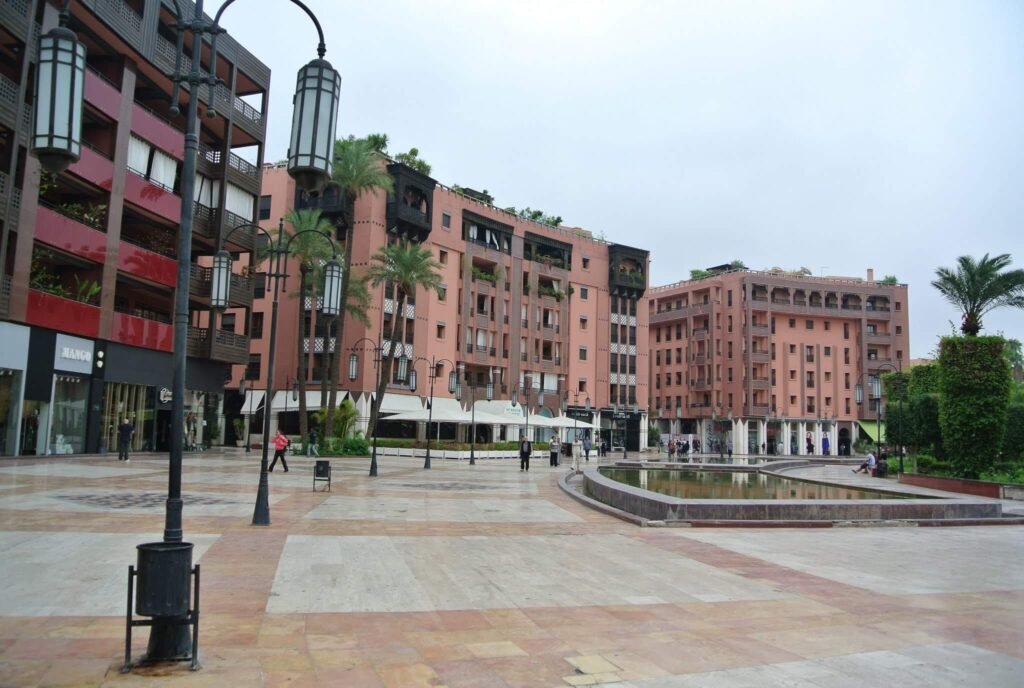
The Medina is historic, walkable, and where traditional riads are found. The Palmeraie is secluded, spacious, and resort-oriented. Hivernage is modern, polished, and close to the city’s best nightlife. The Kasbah is quieter, more local, and still inside the old walls. Gueliz is contemporary, café-rich, and suits urban travelers.
Here’s what each one actually offers.
Medina — Best Area for First-Time Visitors
For a first visit to Marrakech, there’s nowhere better to stay than the Medina. This is the city as it has existed for centuries — a UNESCO-listed labyrinth of narrow alleyways, artisan workshops, ancient palaces, and riads hidden behind unassuming doors.
The experience of staying in a riad is central to what makes the Medina special. From the street, most look like plain walls. Step inside and you find tiled courtyards with orange trees or fountains, carved plaster, cedar wood ceilings, and a rooftop terrace overlooking a sea of terracotta rooftops. The contrast between the animated streets and the calm inside is one of Marrakech’s defining pleasures.
Practically, the Medina is hard to beat. Jemaa el-Fna, the Bahia Palace, the Saadian Tombs, the souks — most of what you came to see is within walking distance. You don’t need taxis. You don’t lose time commuting. The city is right outside your door.
It’s worth being honest about the trade-offs: the streets are busy, navigation takes a day or two to learn, and cars can’t access most alleyways. Luggage arrives by hand trolley. But for travelers who want to be inside Marrakech rather than adjacent to it, the Medina is the only answer.

Palmeraie — Best Area for Resorts & Quiet Escapes
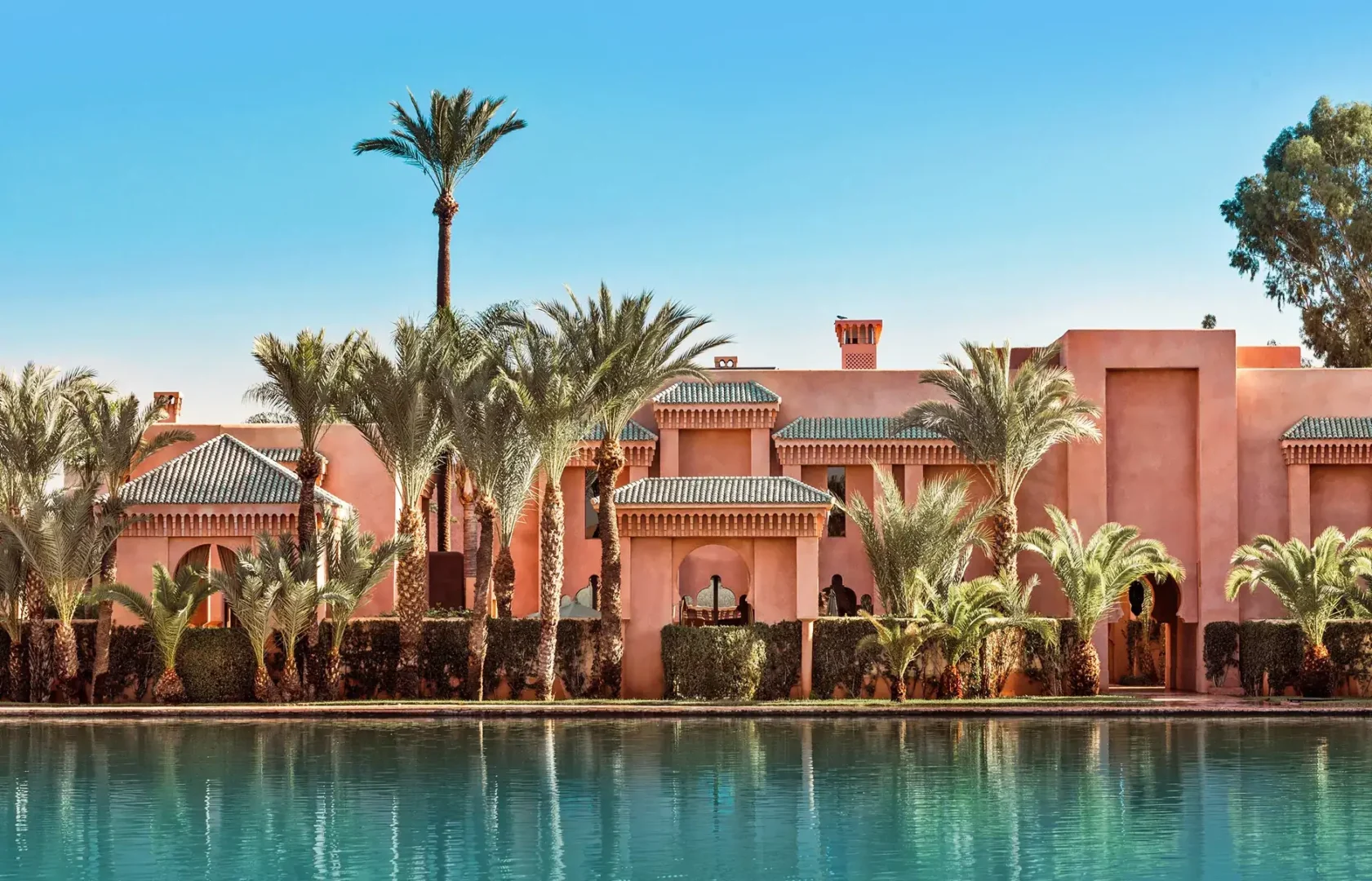
Twenty minutes north of the city, the Palmeraie is a different Morocco entirely. A vast palm grove stretching across several square kilometers, it’s home to some of the most expansive and quietly impressive resorts in North Africa — properties with real gardens, serious pools, and enough space between you and the next guest to actually feel alone.
Staying here means trading the Medina’s intensity for something slower. Mornings begin with breakfast on a sunlit terrace. Afternoons happen by the pool. Evenings, if you want them, involve a taxi into the city and back — most resorts make this easy.
The Palmeraie suits travelers who want Marrakech as an experience rather than a total immersion. It’s particularly well-suited to luxury travelers, honeymooners who want privacy over atmosphere, and families who need space and a pool that children can actually use. It also works well as a base for anyone who finds the Medina overwhelming — you can dip into the old city during the day and return to silence at night.
The one honest limitation: you are not in Marrakech when you’re here. You’re near it. For travelers who want to feel the city’s pulse, the Medina is a better choice.

Hivernage — Best Area for Luxury Hotels & Nightlife
If the Medina is Marrakech’s historic soul, Hivernage is its glamorous, well-groomed counterpart. Built just outside the old city walls, this district of wide palm-lined avenues and elegant hotels offers a version of Marrakech that is polished, convenient, and considerably calmer than the souks.
The hotels here tend to be the large-format luxury variety — expansive properties with serious pools, full spas, multiple restaurants, and the kind of service infrastructure that small riads simply can’t match. For travelers who want five-star comfort and don’t want to trade it for atmosphere, Hivernage makes more sense than the Palmeraie because it sits much closer to the historic center. A taxi to Jemaa el-Fna takes under ten minutes.
Evenings are where Hivernage really earns its reputation. The district hosts some of Marrakech’s best rooftop bars and late-night restaurants, and the city’s most active nightlife scene. If you want to explore Marrakech’s more cosmopolitan side — cocktails at sunset, dinner at a design restaurant, a late evening out — this is where to be.
It’s a natural fit for couples who want luxury without total seclusion, and for travelers who plan to spend their days in the Medina and their evenings somewhere with a little more comfort and edge.

Kasbah — Best Area for Authentic & Peaceful Medina Stays
Tucked along the southern edge of the Medina, the Kasbah offers a quieter, more refined version of Marrakech’s historic heart. The streets are calmer here, the rhythm more local, the atmosphere more intimate — and yet you’re still inside the old walls, minutes from everything that matters.
The area is anchored by two of Marrakech’s most significant sites: the Saadian Tombs and El Badi Palace. Despite this, the Kasbah remains less trafficked than the central Medina — which means the riads here tend to offer a level of quiet that’s increasingly rare closer to Jemaa el-Fna. Beautiful courtyards, rooftop terraces with real views, and a sense of genuine privacy.
What makes the Kasbah work so well is the balance. You can reach the souks and the main square in ten minutes on foot. You can also come back to an evening that’s genuinely quiet. That combination is harder to find than it sounds.
It’s the right choice for couples, culture-focused travelers, and anyone who wants the full Medina experience without being at its loudest point. If the idea of the central Medina feels like too much but you still want to stay within the old walls — the Kasbah is the answer.

Gueliz — Best Area for Cafés, Shopping & Modern Marrakech
Gueliz is the part of Marrakech that surprises people who arrive expecting only ancient medinas. Built during the French protectorate in the early 20th century, it has wide boulevards, Art Deco buildings, proper café culture, gallery spaces, and a restaurant scene that in some ways outpaces the Medina for variety and quality.
Staying in Gueliz feels genuinely urban — more like a relaxed European city than a medieval North African one. That’s not a compromise; for some travelers it’s exactly what they want. Good espresso in the morning. An easy walk to galleries and boutiques. A neighbourhood that moves at a pace you can control.
The practical case for Gueliz is also strong. Accommodation tends to be slightly more affordable than comparable options in the Medina, streets are navigable by car, and a taxi to the historic center takes ten minutes. It works particularly well for longer stays, for travelers who prefer modern amenities, and for anyone who wants to use Marrakech as a base for day trips without dealing with the Medina’s logistical complexity every morning.
The trade-off is atmosphere. Gueliz doesn’t have the magic of a riad courtyard or the sensory intensity of the souks. If that’s what you came for, stay in the Medina. If you want a comfortable, walkable base with easy access to all of it — Gueliz is underrated.

Best Riads & Hotels in Marrakech
Marrakech’s accommodation is genuinely unlike anywhere else. The city’s most distinctive places to stay aren’t hotels in the conventional sense — they’re riads, traditional Moroccan houses organized around interior courtyards, now restored and converted into some of the most atmospheric small guesthouses in the world.
At the same time, Marrakech has developed a serious luxury hotel scene, particularly in Hivernage and the Palmeraie. These properties offer what riads structurally can’t: large pools, full spa facilities, multiple dining options, and the kind of space that makes them work well for families and resort-oriented travelers.
The choice between a riad and a hotel is less about budget and more about what you want the stay itself to feel like. Here’s what each type offers.
Luxury Riads
The finest riads in Marrakech offer something that five-star hotels in most cities simply cannot replicate: the feeling of staying in a private palace hidden inside a medieval city. From the street, nothing announces them. Inside, they reveal carved cedar ceilings, hand-laid zellige tiles, candlelit courtyards with fountains, and rooftop terraces that look out over the Medina’s endless terracotta skyline.
Luxury riads typically have between five and fifteen rooms, which keeps the atmosphere genuinely intimate. Service is attentive in a way that feels personal rather than procedural — breakfasts prepared to order in the courtyard, staff who remember your preferences, owners who are often on-site and deeply invested in the experience.
The amenities have kept pace with expectations: plunge pools, in-house hammams, and private dining are now common at the upper end of the riad market. What hasn’t changed is what makes them special — the architecture, the silence behind the door, and the sense of having found something that most of the city walks past without knowing it’s there.
Best for couples, honeymooners, and travelers who want an authentic experience at the highest level of comfort.

Boutique Riads
Boutique riads sit in the space between luxury and budget — and for many travelers, they’re the sweet spot. These are smaller guesthouses, typically under ten rooms, where the owner is usually present, the recommendations are genuine, and the stay feels less like a hotel and more like being invited into someone’s beautifully restored Moroccan home.
Design matters here. The best boutique riads are deeply considered spaces — some lean into classical Moroccan craftsmanship with antique furnishings and colorful tilework; others mix traditional elements with contemporary design in ways that feel fresh without losing their character. The result is often the most photogenic category of accommodation in the city.
The location is almost always inside the Medina, which means you’re close to everything. The size means the experience is personal. And the price — typically a step below luxury riads — makes them excellent value for what they offer.
Best for couples, solo travelers, and anyone who values atmosphere and character over facilities and size.

Budget Riads
One of the genuinely pleasant surprises about Marrakech is that you don’t need to spend a lot to stay somewhere with real character. Budget riads exist in proper numbers in the Medina, and many retain the essential qualities — a courtyard, tiled floors, a rooftop terrace — that make this style of accommodation worth seeking out in the first place.
The trade-offs are real: rooms may be smaller, bathrooms simpler, and amenities limited. But the location is often identical to riads at three times the price — inside the Medina, within walking distance of everything. And the welcome at a family-run budget riad is frequently warmer than at a more polished establishment. Hosts who run these properties tend to know the city well and share that knowledge generously.
For backpackers, solo travelers, and anyone who believes the experience of a place matters more than the thread count — budget riads are one of the best-value ways to stay in Marrakech.

Luxury Hotels
For travelers who want the scale and facilities that riads structurally can’t provide, Marrakech’s luxury hotels are genuinely impressive. These are large-format properties — expansive gardens, serious pools, award-winning spas, multiple restaurants — built for travelers who want a resort experience alongside access to a remarkable city.
Most are located in Hivernage, Gueliz, or the Palmeraie, where there is space for proper grounds and easy car access. The design quality is high across the board — Marrakech seems to attract hotel projects that take their architecture seriously, with properties that nod to Moroccan craftsmanship while delivering contemporary comfort.
The practical advantages over riads are clear: larger rooms, consistent service infrastructure, pools that children can actually swim in, and the kind of facilities that make a long stay genuinely comfortable. The trade-off is that you’re one step removed from the texture of the city — the alleyways, the unexpected encounters, the feeling of being inside something ancient and alive.
Best for families, resort-oriented travelers, and anyone who wants Marrakech’s culture by day and serious comfort by night.

Family-Friendly Stays
Marrakech works well for families — but the right accommodation makes a significant difference. The Medina’s narrow alleyways and riad layouts can be challenging with young children, while resorts in the Palmeraie and hotels in Hivernage or Gueliz are designed for exactly this kind of travel.
The priorities are straightforward: space, a safe pool, connecting rooms or suites, and proximity to things that work for all ages. The best family-friendly properties in Marrakech tick all of these while also offering enough atmosphere to remind you that you’re not in a generic hotel chain.
Some riads have adapted well to families — particularly larger ones with private terraces and garden spaces. But for most families, especially those with younger children, a resort-style hotel gives everyone more room to breathe and keeps the logistics manageable.
The city itself is excellent with children — the souks are endlessly fascinating at any age, the food is accessible and varied, and day trips to the Atlas foothills or the Ourika Valley are genuinely enjoyable for families.

Romantic Riads & Hotels
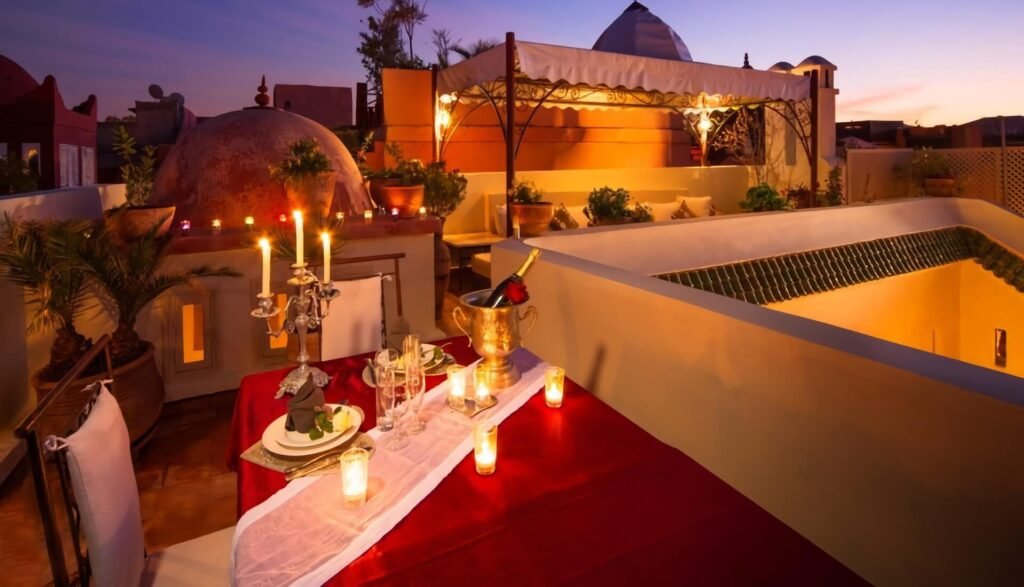
Marrakech has a strong case for being one of the most romantic cities in the world. The combination of candlelit courtyards, rooftop terraces at sunset, private hammams, and a city that rewards slow evenings makes it a natural choice for couples — and the accommodation reflects that.
The most romantic stays tend to be intimate riads: five or six rooms at most, a courtyard that feels genuinely private, a plunge pool, a terrace where breakfast arrives without needing to be requested. These are places where the staff-to-guest ratio is high enough that the experience feels bespoke rather than managed.
For couples who want more space and resort amenities alongside the romance — a suite with a spa bath, a private villa with a pool, access to a couples’ hammam — the luxury hotels in the Palmeraie and Hivernage deliver at a high level.
What matters most is the atmosphere, and Marrakech has that in abundance. Even a modest riad, well chosen, can produce evenings that are difficult to replicate anywhere else.

Best Areas to Stay in Marrakech by Travel Style
The right neighborhood depends less on your budget than on what kind of trip you want to have.
First-time visitors: Stay in the Medina. Proximity to the souks, the palaces, and Jemaa el-Fna matters more on a first trip than anything else. The immersion is worth the initial navigation challenge.
Luxury travelers: Hivernage for large hotels close to the city. Palmeraie for resort-style seclusion and serious space. The choice comes down to whether you want to be near the city or retreated from it.
Nightlife and dining: Hivernage is the clear answer — the best bars, rooftop restaurants, and late-night options in Marrakech are concentrated here.
Culture and authentic atmosphere: Medina or Kasbah. The Kasbah gives you everything the Medina does with noticeably less noise and foot traffic.
Quiet escape: Palmeraie. Nothing else in Marrakech competes on serenity and space.
Contemporary city experience: Gueliz. The best cafés, the most interesting independent shops, and a pace that suits longer stays or travelers who prefer urban environments.
Tips for Choosing the Right Accommodation in Marrakech
A few things that make a real difference and aren’t always obvious from booking platforms.
Riad vs hotel — the honest trade-off
Riads give you atmosphere, intimacy, and location inside the Medina. They tend to be smaller, quieter, and more personal. Hotels give you space, facilities, and consistent service infrastructure. They make more sense for families, for travelers who prioritize a pool, and for anyone who finds the Medina logistically challenging. Neither is objectively better — they suit different travelers.
Location within the Medina matters
The Medina is large and not all parts feel the same. A riad near Jemaa el-Fna is convenient but noisier. A riad in the Kasbah is quieter but slightly further from the main souks. Check the map before booking, not just the photos.
Book directly with the riad if you can
Many riads offer better rates for direct bookings, and it starts the relationship on a better footing. Riads are run by people, not algorithms — reaching out directly often gets you a better room, better information about arrival logistics, and better service throughout your stay.
Prioritize a rooftop terrace
Almost every riad has one and it matters more than you expect. Breakfast with a view of the Medina, a late glass of wine at sunset, a quiet read in the afternoon — the terrace becomes a significant part of how you experience the city.
Get a pool if you’re visiting in summer
From May through September the heat is serious. A plunge pool or courtyard pool transforms the experience. In a 38°C afternoon it’s not a luxury — it’s the difference between a good day and a difficult one.

FAQ — Where to Stay in Marrakech
What is the best area to stay in Marrakech?
Is it better to stay in a riad or a hotel in Marrakech?
Riads offer an experience that hotels can’t — intimate courtyards, traditional architecture, and a feeling of being inside the city rather than next to it. Hotels offer what riads structurally can’t provide: large pools, consistent facilities, and space. The right choice depends on whether you’re prioritizing atmosphere or amenities.
Is the Medina safe for tourists?
Yes. Millions of visitors stay in the Medina each year without issue. The usual common-sense rules apply — watch your belongings in crowded areas, avoid poorly lit alleys late at night. The Medina is less intimidating than first impressions suggest, and Moroccan hospitality is real.
What area of Marrakech is best for first-time visitors?
The Medina, without question. Staying here puts you within walking distance of everything worth seeing, and the experience of navigating the old city — even getting briefly lost — is part of what makes a first visit memorable.
How many nights should you stay in Marrakech?
Three nights is the minimum for a satisfying first visit — enough to cover the main sites, eat well, and start to feel the rhythm of the city. Four nights is better, and allows for a day trip to the Atlas Mountains or Essaouira. Five or more is when you really start to slow down and discover things that aren’t on any list.