
Currency and tipping covered, the remaining preparation connects to the logistics and practicalities that make the trip itself run smoothly. These four guides address the areas most visitors wish they’d read before arriving.
Currency & Tipping in Morocco: Quick Guide
Morocco uses the Moroccan Dirham (MAD), a closed currency that cannot be exchanged outside the country. Cash is the primary payment method in the Medina, markets, taxis, small restaurants, and any context outside major hotels and chain shops — cards are accepted in larger establishments but are unreliable below a certain transaction size and environment. Tipping is expected and specific: 10–15% in restaurants, 10–20 MAD for hotel staff per service, and 50–100 MAD per day for tour guides.
Pro tip: Keep a supply of small bills and coins throughout the trip. The 200 MAD note is too large for most Medina transactions; 20 and 50 MAD notes and coins are the correct working denominations for taxis, market stalls, street food, and tips.
- Dirham
- closed currency — obtain on arrival, reconvert before departure
- Working notes
- 20 & 50 MAD — the 200 MAD note is too large for most Medina transactions
- ATM fee
- €3–5 per withdrawal — withdraw larger amounts less often
- Tour guide tip
- 50–100 MAD per person per day
Master Money & Tipping in Morocco: A Traveler’s Guide
The Moroccan Dirham’s closed-currency status is the single most important financial fact for visitors: dirhams obtained before arrival are not genuinely available (the MAD is not traded internationally), and dirhams remaining at departure need to be reconverted before leaving Morocco. Everything else about money management in Morocco is practical rather than complicated — the Medina is a cash environment, the major hotels and restaurants take cards, and the ATM network in the cities is reliable.
This guide covers the dirham, the cash-versus-card breakdown by context, where and how to exchange money, the full tipping framework by service type, and the specific mistakes worth avoiding.
Insider insight: Arriving with small dirham notes — obtained from the airport ATM immediately on arrival — is the single most useful financial preparation for Marrakech. The first taxi ride, the first tea at the riad check-in, and the first souk purchase all require cash, and the airport ATM is the most reliable and cost-effective source for it.
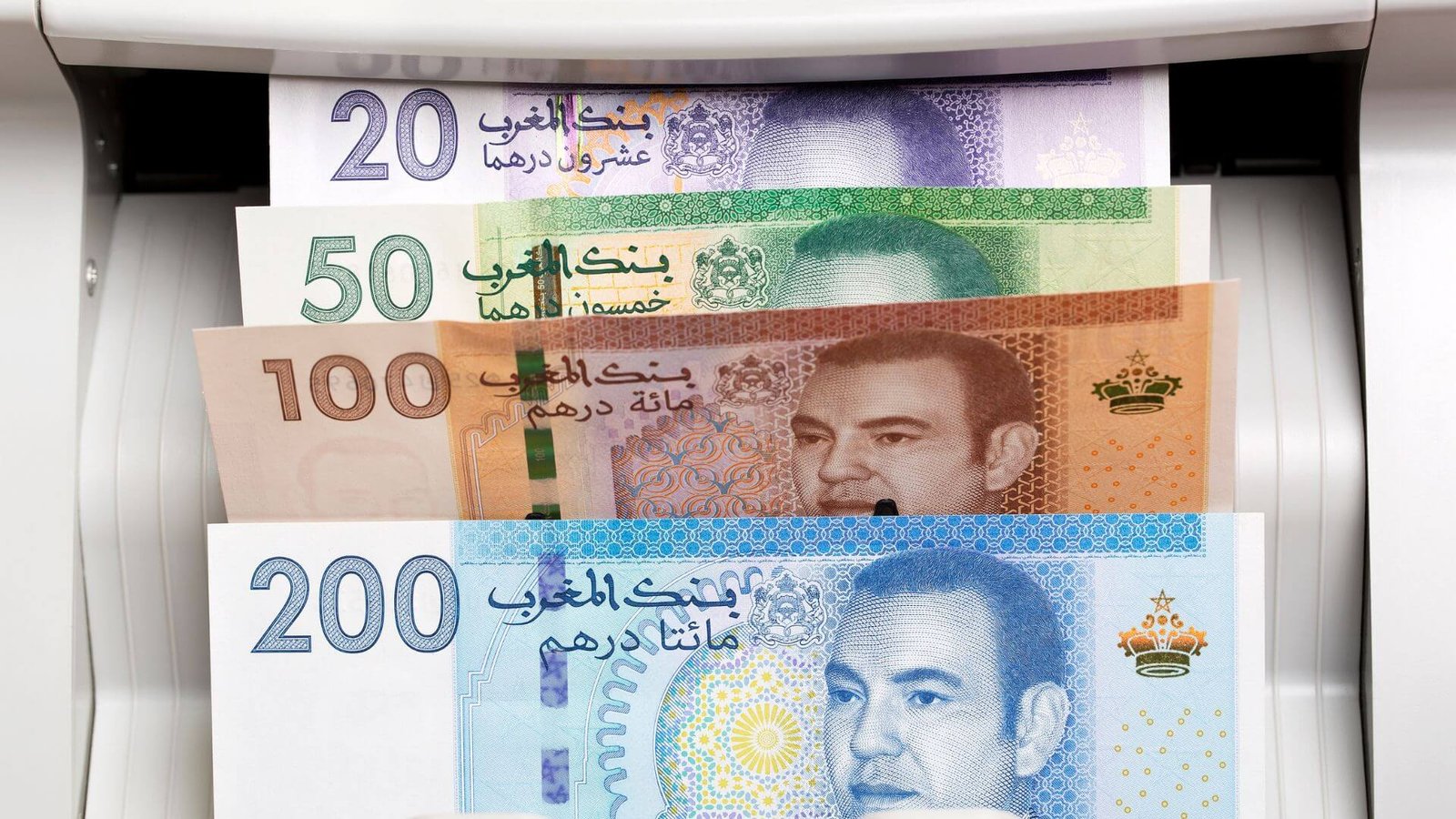
Morocco currency — dirhams can't be bought before you arrive or taken home after: use the airport ATM on arrival, keep small notes throughout, and leave nothing unconverted at departure
Currency in Morocco: The Moroccan Dirham (MAD)
The Moroccan Dirham (MAD) is Morocco’s official currency and a closed currency — it cannot be purchased before arrival through international banks or currency exchange services at meaningful rates, and unspent dirhams must be reconverted to a hard currency before leaving Morocco (with receipt required; see below). The practical implication is straightforward: obtain dirhams on arrival at the airport ATM or bank, budget daily cash needs by activity type, and reconvert any remaining balance at the airport before departure.
Cash vs Card
- Cash: the correct payment method for petit taxis, street food, souk and market purchases, hammam attendants, local guides, and any transaction in the traditional Medina. Carry 20 and 50 MAD notes as the working denominations; avoid presenting a 200 MAD note for small purchases as change is frequently unavailable.
- Card: accepted at major hotels, riad check-ins (for deposits and final bills), mid-range and upmarket restaurants in Gueliz and the Medina, and larger souvenir and craft shops. Visa and Mastercard are the standard; Amex is accepted at fewer establishments. Contactless is available at some but not all terminal-equipped venues.
- ATMs: widely available in Marrakech and Morocco’s other major cities — Banque Populaire and Attijariwafa machines at or near the airport are the most reliable options for first-withdrawal. Foreign card fees are typically EUR 3–5 per withdrawal on top of your home bank’s international fee; withdraw in larger amounts less frequently to minimise this cost. ATMs in remote areas (Atlas Mountain villages, smaller Saharan gateways) are absent or unreliable — plan ahead.
Currency Exchange Tips
- Exchange at official bank branches or licensed exchange bureaux (bureaux de change) — identifiable by their official signage and fixed rate boards. Street exchangers offer apparently favourable rates but operate outside the legal framework and commonly use sleight of hand to short-change.
- Keep your exchange receipt. Moroccan law permits reconversion of unspent dirhams to a hard currency at departure only against presentation of the original exchange receipt; without it, the reconversion is refused.
- Exchange rates vary marginally between official institutions; the airport bureau rate is slightly less favourable than the in-city bank rate — if you have time, a city-centre Banque Populaire branch produces better value than the airport exchange desk.
Pro tip: The most cost-effective approach for most visitors is to withdraw dirhams from the airport ATM on arrival (avoiding airport bureau exchange rates entirely) and top up at a city-centre ATM mid-trip if needed. This eliminates the exchange receipt reconversion requirement since ATM-obtained dirhams are not subject to the same reconversion documentation rules.
Tipping Etiquette in Morocco
Tipping in Morocco is not optional in the way it might be in northern European contexts — it is the expected and functional component of service compensation across most hospitality and guided service interactions. The amounts are modest by European standards and the absence of a tip where one is expected is noticed. The framework below covers the specific contexts and amounts.
Restaurants
- Casual & Small Restaurants: rounding up to the nearest 5 or 10 MAD, or 5–10% of the total — whichever produces a more natural figure. Small local restaurants often do not issue itemised bills; a few coins left on the table is appropriate.
- Mid-range & Fine Dining: 10–15% of the bill is the expected amount at restaurants with table service and a formal menu. Some mid-range restaurants add a service charge; check the bill before adding a separate tip.
- Street Food: 2–5 MAD per item or per interaction at a stall. Not obligatory but appreciated, particularly at stalls where you’ve spent time eating at their tables.
Hotels & Riads
- Bellboys & Porters: 10–20 MAD per bag carried — give at the time of the service, not at checkout. Multiple bags warrant the higher end of the range.
- Housekeeping: 10–20 MAD per night, left in the room daily rather than as a lump sum at checkout (to ensure it reaches the person who cleaned).
- Concierge: 20–50 MAD for meaningful assistance — restaurant reservations, transport arrangements, activity bookings, or directions that saved significant time.
Guides & Drivers
- Tour Guides: 50–100 MAD per person per day for a qualified guide on a full-day excursion; scale down proportionally for half-day or shorter sessions. Quality and engagement matter; at the higher end, the tip signals genuine satisfaction.
- Private Drivers / Taxis: for petit taxis, round up to the nearest 5 MAD — exact change is not expected. For private drivers on day trips, 50–100 MAD for the full day is appropriate; 100–150 MAD for exceptional service on a long excursion.
Pro tip: Pay tips in cash and in dirhams directly to the individual rather than adding to a card payment — card tips frequently don’t reach the intended recipient in smaller establishments.
Money-Saving & Safety Tips in Morocco
- Use ATMs wisely: withdraw from the machines of established banks (Banque Populaire, Attijariwafa, BMCE) rather than standalone ATMs in unfamiliar locations. Cover the keypad when entering your PIN. Avoid machines that have visible tampering around the card slot. The airport machines on arrival are the safest first withdrawal.
- Carry small bills: the souk economy runs on 10, 20, and 50 MAD denominations. A 200 MAD note presented for a 15 MAD purchase in a small stall will produce one of two outcomes: a long wait while the seller finds change, or a claim that change isn’t available and a pressure to spend more. Neither is the correct starting point for a negotiation.
- Negotiate politely: bargaining is the correct mode of transaction in the souks — it is not a confrontation but a ritual both parties understand and often enjoy. Start below your target price, move slowly, and be prepared to walk away. Agreeing on a price and then renegotiating downward after the item is wrapped is considered disrespectful and affects subsequent interactions with that merchant.
- Plan your budget: approximate reference prices for Marrakech in 2026 — petit taxi: 20–40 MAD for a city crossing; street food: 10–30 MAD per item; basic set lunch: 60–100 MAD; mid-range restaurant dinner per person: 150–300 MAD; riad rates: EUR 80–250 per night depending on category.
- Split your cash: keep the day’s working cash in a crossbody bag or front pocket in the Medina, and leave the remainder of your cash supply in the riad safe. This limits the financial exposure of any single theft or loss incident.
- Check card fees: international transaction fees on European cards typically run 1.5–3% per transaction; North American cards vary widely. A travel-oriented card (Revolut, N26, Wise) with no foreign transaction fees saves a meaningful amount over a two-week trip.
Pro tip: A secondary payment option — a prepaid travel card with a separate PIN from your main card, kept in a different location — provides the practical backup that matters when your main card is declined, the ATM eats it, or it’s pickpocketed in the Medina. This is not alarmism; it’s a standard travel precaution for any cash-forward destination.
Frequently Asked Questions about Money & Tipping in Morocco
What is the official currency in Morocco?
The Moroccan Dirham (MAD) is Morocco’s official currency. It is a closed currency, meaning it cannot be bought or sold outside Morocco at official rates and cannot be exported in meaningful quantities. Obtain dirhams on arrival at the airport ATM or bank; reconvert any unspent balance before departure at the airport exchange, with your original exchange receipt if you used a bureau de change.
Can I use my credit or debit card everywhere?
No. Cards work reliably at major hotels, upmarket restaurants, and larger established shops. They are not accepted at petit taxis, street food stalls, most souk vendors, hammams, local guides, and any context involving small transactions in the traditional Medina. The correct approach is to maintain a working cash balance throughout the trip and use cards selectively for larger transactions where acceptance is confirmed in advance.
How much should I tip in Morocco?
The framework: 10–15% in sit-down restaurants; 10–20 MAD per bag for hotel porters; 10–20 MAD per night for housekeeping (paid daily); 50–100 MAD per person per day for tour guides; and rounding up to the nearest 5 MAD for petit taxi fares. Street food vendors appreciate 2–5 MAD but it’s not mandatory. All tips in cash and in dirhams directly to the individual.
Where is it safest to exchange money?
At official bank branches (Banque Populaire, Attijariwafa, BMCE) or licensed bureaux de change with a clearly displayed rate board. The airport ATM on arrival is the most efficient option for most visitors — it provides dirhams at the interbank rate minus your home bank’s withdrawal fee, and eliminates the exchange receipt reconversion requirement. Avoid street exchangers entirely.
How can I avoid extra fees when paying or withdrawing money?
Three strategies: withdraw larger amounts less frequently to reduce the fixed per-withdrawal fee; use a travel card with no foreign transaction fee (Revolut, Wise, N26) for card payments where cards are accepted; and choose to be charged in MAD rather than your home currency when given the choice at a card terminal (the “dynamic currency conversion” to your home currency always applies a worse rate).
Plan the Rest of Your Moroccan Adventure
-
Complete Morocco Packing List
What to bring for Marrakech's specific combination of heat, culture, and activities — with specific guidance for the Medina, desert excursions, and the Atlas
-
Travel Insurance for Morocco
The two Morocco-specific coverage gaps most standard policies miss: medical evacuation from remote areas and activity cover for adventure excursions
-

Morocco Visa Guide
Entry requirements by passport nationality, the 90-day limit, and the documentation that border officers can request even from visa-exempt travellers
-

SIM Cards & Internet
The three Moroccan operators, where to buy at Menara airport, what coverage looks like in the Atlas and desert, and when an eSIM makes more sense than a physical card
 Marrakist Concierge